


By Lim Hwee Ming, Senior Librarian, Instruction & Learning Services, Redzuan Abdullah, Senior Librarian, Research & Data Services & Tee Lip Hwe, Senior Librarian, Research & Data Services
Artificial intelligence is increasingly embedded within financial research platforms, reshaping how users discover, interpret, and extract data. From natural language interfaces to automated summarisation and sentiment analysis, these tools promise greater efficiency but also introduce new considerations around accuracy and interpretation.
This article reviews emerging AI-powered capabilities across key financial databases: WRDS, Bloomberg, and Fitch Connect; highlighting their strengths, limitations, and practical implications for research workflows.
1. WRDS – A Review of the Ask AI Chatbot (Beta v0.5)
The latest iteration of the WRDS Ask AI Chatbot (Beta v0.5) aims to deliver a more seamless user experience through natural language interaction. In practice, results improve when users ask clarifying follow-up questions and provide more specific prompts.
Accessing the Chatbot

The Ask AI Chatbot is located at the top right of the WRDS platform.
Initial Observations
In an initial test query using the keyword “Capitalized Software”, the chatbot returned results from datasets outside institutional subscriptions; results with wrong indexed documents. This highlights a key limitation: the chatbot does not automatically restrict outputs to subscribed datasets. As such, prompt design becomes critical to improving relevance.
Effective Prompting Strategies
For more accurate results:
- Formulate queries in clear, complete sentences.
- Specify key parameters such as:
- Time horizon (e.g. 1990–2000)
- Geographic scope (e.g. North America)
- Reporting frequency (e.g. quarterly, monthly)
- Variable names (e.g. development costs, computer software)
- Dataset names (e.g. Compustat Global, FactSet, Thomson Reuters Worldscope)
Begin with simple queries and progressively refine them. The chatbot supports up to six questions per session, with recommended prompts under 200 characters.
Query Structuring Matters
Starting with complex queries may result to vague and repetitive responses under Reasoning (e.g. “does not define a special dataset”). In contrast, building from simple questions to complex questions can improves the clarity and precision.
Validation and Refinement
When the chatbot suggests alternative variables: “Computer software” or “Development costs”, these should always be verified against official WRDS documentation (Data Definition Guides or Data Schema). Once the sources are verified, these alternatives variables can be incorporated into subsequent queries in the chatbot.
Improving Search Precision
- Specify company entities (e.g. public-listed firms) to help the chatbot identify relevant datasets.
- Narrow geographic focus (e.g. Austria, Germany, Switzerland) to filter dataset coverage appropriately.
- Prompt comparisons across datasets (e.g. Compustat Global, Thomson Reuters Worldscope, FactSet) to evaluate trade-offs.
- Request structured outputs by adding instructions such as “Generate a table.” for enhanced data visualization.
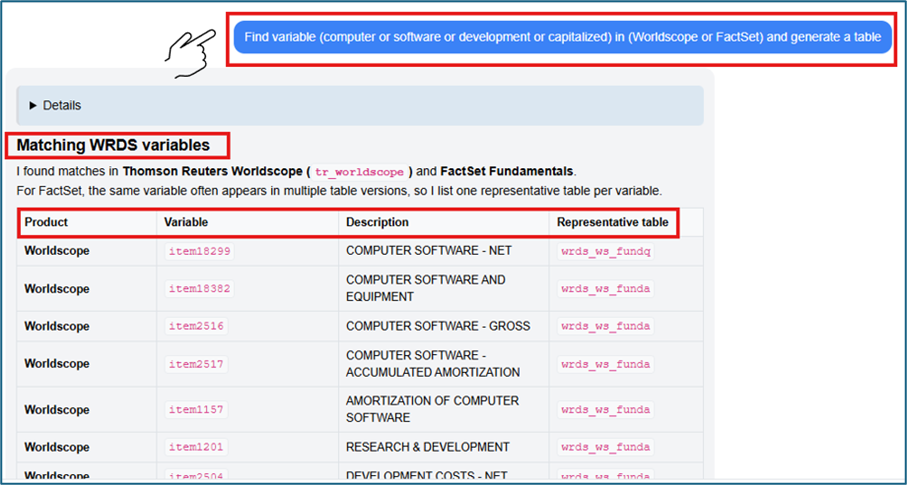
Interpreting AI Reasoning and Toolcall
Expanding the “Details” section reveals the chatbot’s reasoning and methodology. This can help the researcher assess whether the chatbot’s assumptions and recommendations align with their research intent.
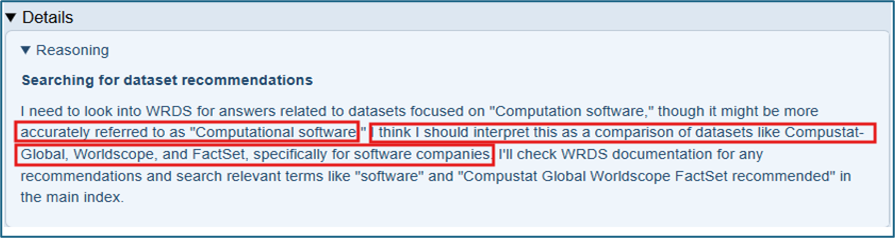
However, reasoning can sometimes lack precision, with ambiguous interpretations.
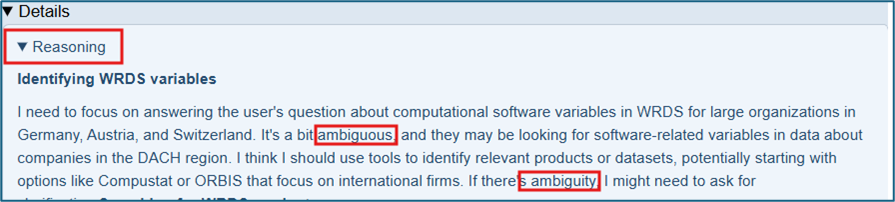
Enhancing Outputs with Role Assignment
Assigning a role (e.g. “identify variables most useful for a finance model”) can significantly improve output relevance.
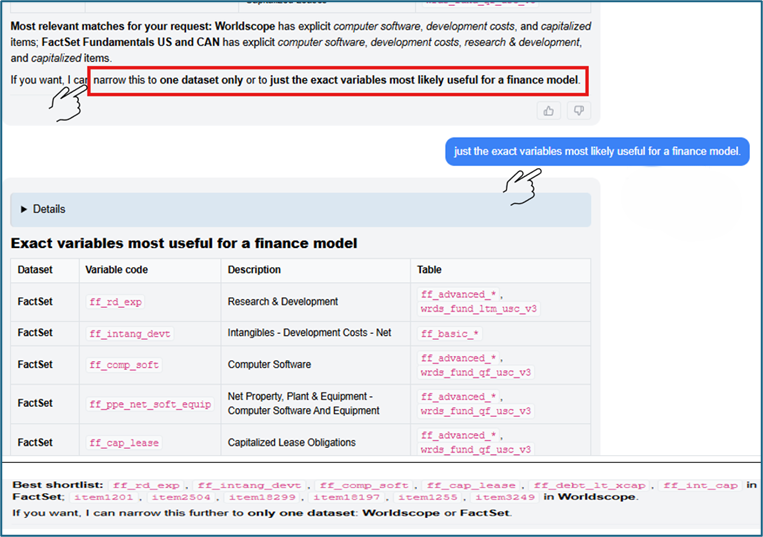
The WRDS Ask AI Chatbot is most effective for:
- Identifying data variables
- Understanding definitions
- Comparing datasets
However, outputs must always be verified against official WRDS documentation to ensure accuracy, relevance and reliability.
2. Bloomberg AI
The Bloomberg Terminal integrates financial data, news, and research into a unified platform for fast access. Its AI capabilities enhance discovery, extraction, summarisation, and enrichment; particularly by transforming unstructured data into usable forms and insights.
This section highlights two AI-enhanced functions:
- AID (Automated Intelligence on Demand)
- GN (News Activity Chart)
Bloomberg AID (Automated Intelligence on Demand)
The AID function generates automated summaries and reports for for single equity, based on market current data, allowing you to access key drivers or information. For equity index, it can be customised based on your selected timeframes.
In the example below, key metrics and insights for the Straits Times Index (STI) are generated for Q1 2026 using the time-span selector.
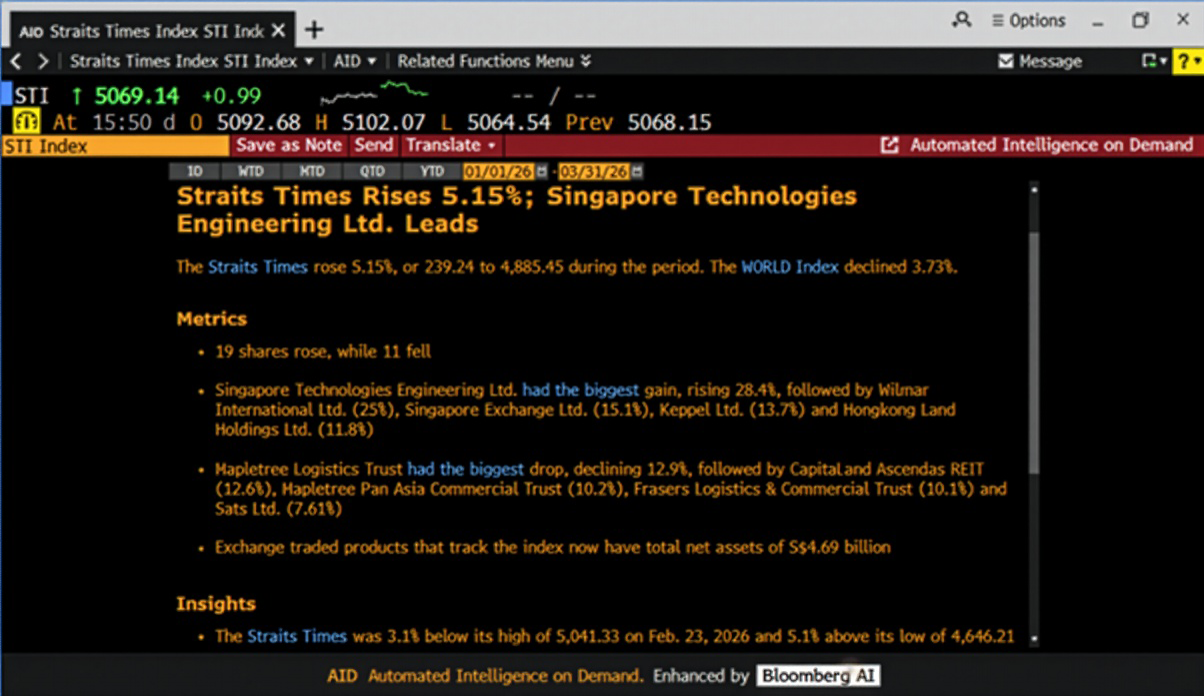
Given its generative prowess, it is hoped that in future enhancement the AID function generates key information for single-name equities like Vanguard S&P 500 ETF (VOO US Equity), based not only on current data, but a user-selected historical window, for deeper analytics.
Bloomberg GN (News Activity Chart)
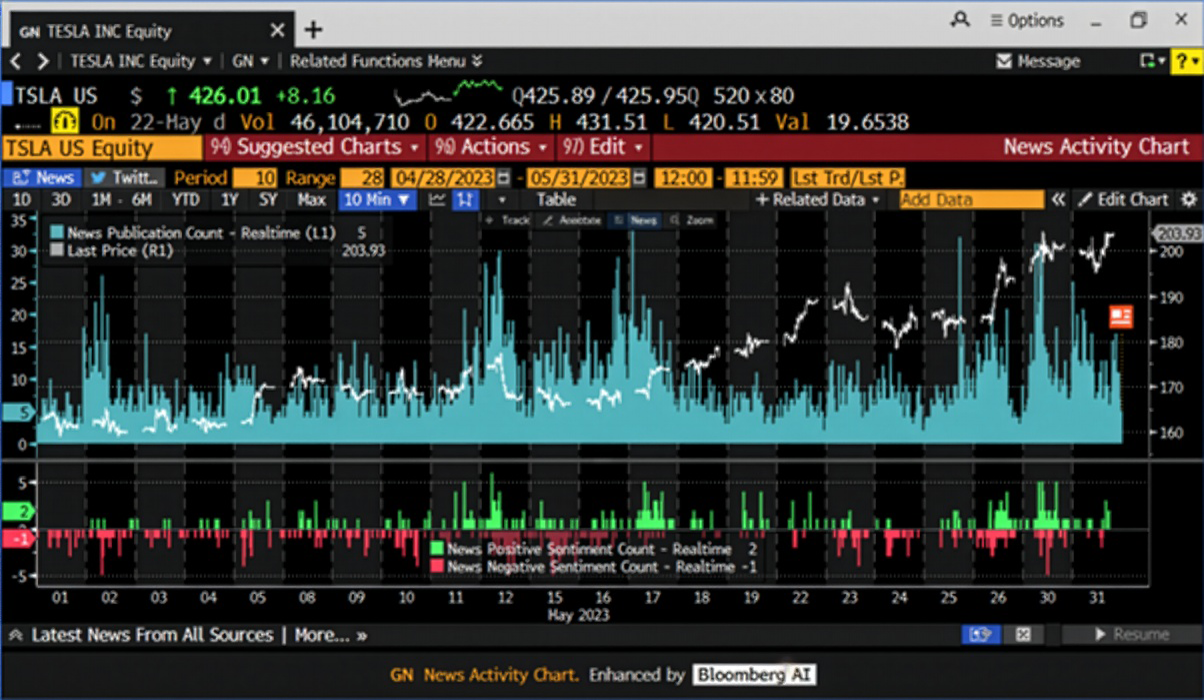
The GN function applies AI to identify and correlate news activity with company performance.
It visualises:
- News publication count
- News positive and negative sentiment counts
- Price and related data item movement (e.g. Tesla Inc. intraday data)
The screenshot shows plots of News Publication Count, News Positive Sentiment Count, and News Negative Sentiments Count, against intraday traded price of 10-minute interval, of Tesla Inc.
Data can also be exported in tabular format for further analysis:
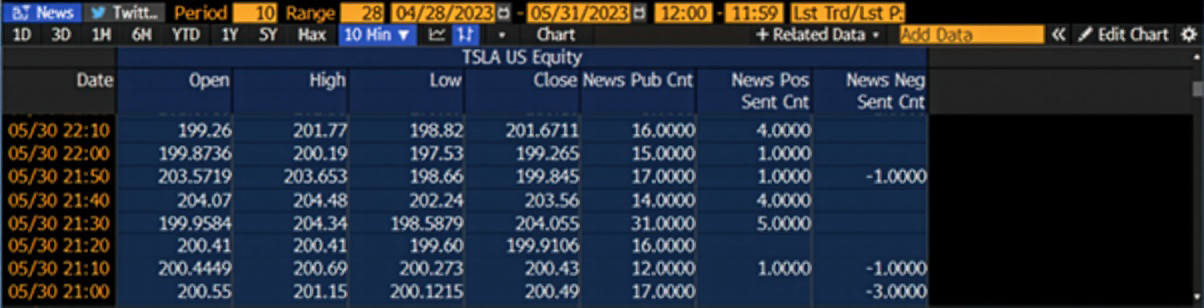
While the GN function is not restricted to returning intraday history within a rolling window of the most recent 140 weekday trading days unlike the Bloomberg’s =BDH() formulation via MS Excel, a key limitation is that retrieval of higher-frequency data (e.g. 1-minute intervals) is restricted by shorter trading-day input window, i.e. the permissible trading-day input window is typically shorter for 1-minute intraday data than for 10-minute intraday data.
Further Exploration
For a broader overview of Bloomberg’s AI capabilities, including its generative AI roadmap, as well as other functions augmented by Bloomberg AI, refer to the AIBB (Overview of Bloomberg AI) function.
3. Fitch Connect Genie
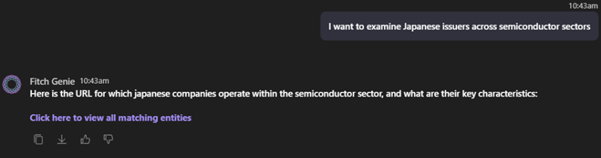
In this session, Fitch Genie was prompted to examine Japanese issues operating in the semiconductor sector.
Key Observations
Fitch Genie shows promise as a narrative discovery tool, but is less reliable for structured data retrieval.
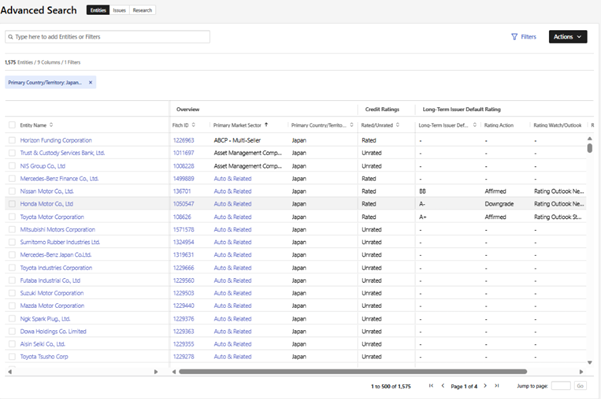
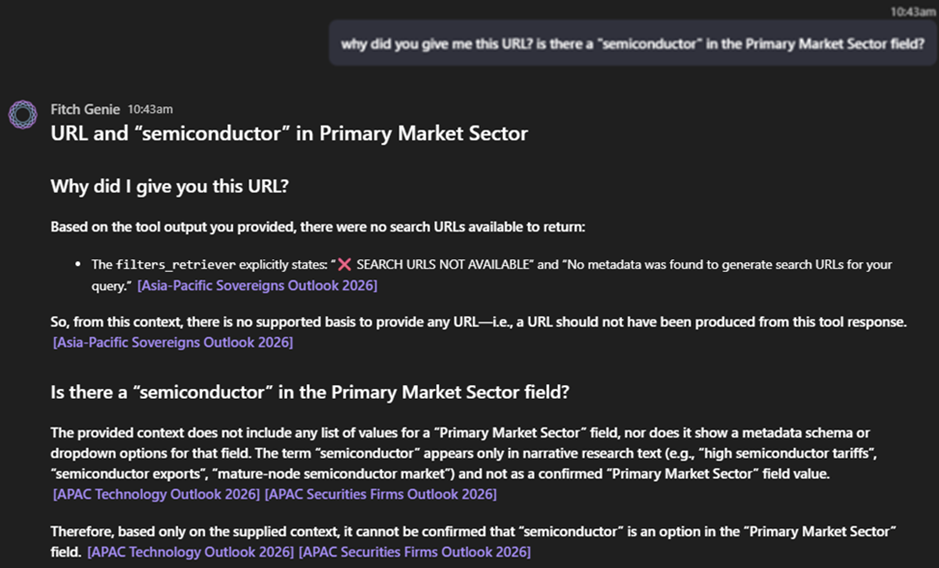
Its first response implied that it had found a URL/list of Japanese semiconductor-sector entities [below], but the actual Fitch advanced search page only showed a broad filter: Primary Country/Territory: Japan. There was no visible “semiconductor” filter in the Primary Market Sector field. That means the AI appeared to overstate what the underlying search interface actually supported.
When challenged, the system acknowledged the limitation and clarified that the output was not based on a valid structured filter, demonstrating useful self-correction behaviour.
Limitations in Output Scope
The final response identified only Renesas Electronics Corporation from narrative sources.
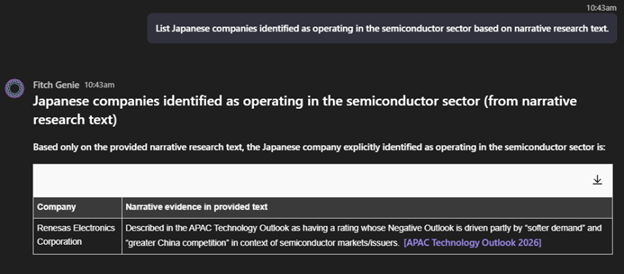

While accurate within retrieved documents, this does not represent a comprehensive list of semiconductor issuers. Results depend heavily on the specific documents retrieved, rather than a structured taxonomy.
Prompting Considerations
Ambiguity in user queries (e.g. “semiconductor sector”) can lead the system to interpret concepts narratively rather than structurally. More precise prompts aligned with Fitch’s taxonomy improve outcomes. The initial query was broad and left room for interpretation. Fitch Genie appeared to treat “semiconductor sector” as a thematic/narrative concept rather than a confirmed structured field in Fitch’s entity taxonomy. The onus is on the user to come up with a better prompt such as below:

Conclusion
Across WRDS, Bloomberg, and Fitch Connect, AI tools are proving most valuable as assistive layers for exploration, summarisation, and discovery. While these tools can significantly accelerate initial research, through natural language querying, automated insights, and narrative surfacing, their outputs are shaped by prompt design, underlying data constraints, and system interpretation.
A consistent takeaway is the continued importance of human oversight. Researchers must validate AI-generated results against authoritative documentation, structured search filters, and original data sources. Used critically and strategically, these AI capabilities can enhance research efficiency; used uncritically, they risk introducing ambiguity or overinterpretation.
As these tools continue to evolve, developing strong prompting skills and verification practices will be essential for leveraging their full value in financial research.
Notes
- To access WRDS and Fitch Connect, visit SMU Libraries’ A–Z Databases
- To access Bloomberg Terminal, visit Investment & Data Studio at Li Ka Shing Library
- The new features highlighted in this article reflect ongoing development. Their availability may change or evolve over time, depending on future updates or strategic considerations at the discretion of the product or vendor team.
References
Bloomberg L.P. (2026). Bloomberg Terminal.
FitchConnect (2026). Genie AI.
Wharton Research Data Services (WRDS) (2026). Ask AI Chabot.