

By Yeo Pin Pin, Head, Research Services
Scopus has released the 2025 edition of CiteScore, its journal evaluation metric often compared to Clarivate’s Journal Impact Factor (JIF). You can explore the updated list at Scopus Sources.
For SMU users, the best route is via the SMU Libraries subscription:
- Go to Databases > Scopus
- Click on Sources in the top menu bar. This pathway unlocks richer details, including the articles published in each journal and the citing articles that contribute to its score.
How CiteScore Differs
Unlike JIF, CiteScore draws on the broader coverage of Scopus. This means:
- More journals are included: Over 13,000 titles have a CiteScore but no JIF.
- High-impact representation: Around 700 of these journals rank in the top 10% percentile within their subject areas. Source: factsheet on CiteScore Metrics
This wider net is especially valuable for disciplines and regional journals that may not be indexed in Web of Science.
How CiteScore is Calculated
CiteScore uses a four-year window:
- Citations received in 2022–2025
- Divided by all documents published in the same period
This differs from JIF’s two-year window and narrower definition of “citable items.”
CiteScoreTracker: Real-Time Transparency
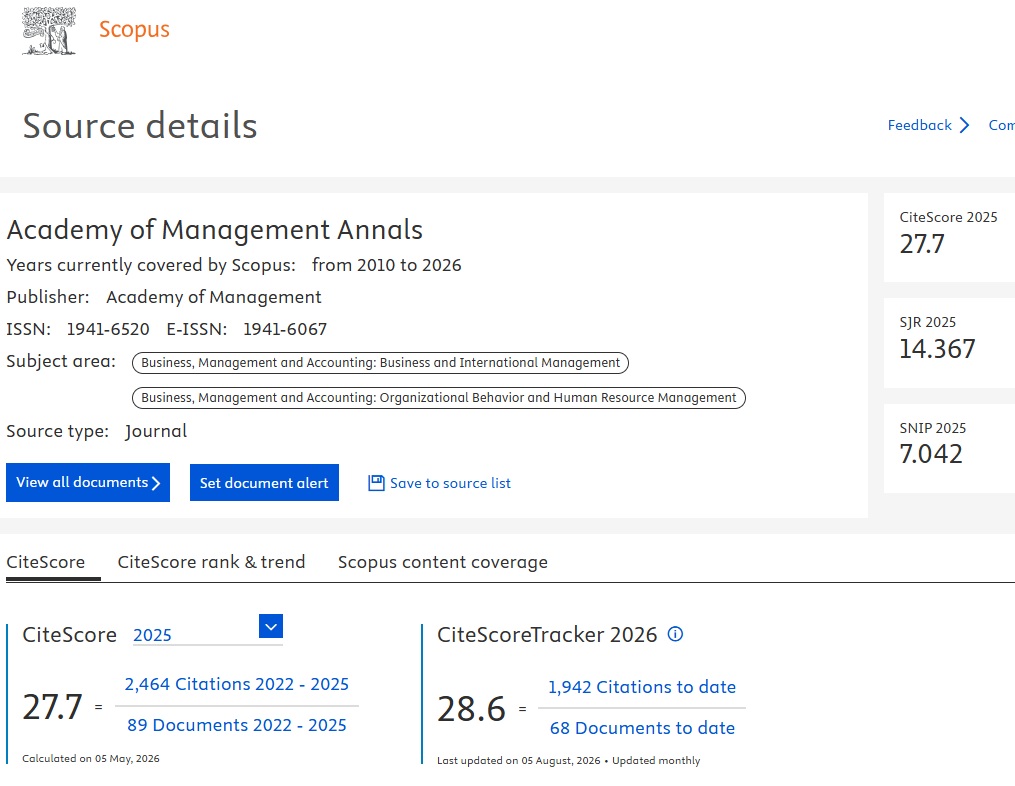
A unique feature of Scopus is the CiteScoreTracker, which updates monthly. It provides a running estimate of the next year’s CiteScore, offering early insight into how a journal’s influence is trending.
Complementary Metrics
On each journal’s source details page, you can also compare:
- Scimago Journal Rank (SJR), which includes prestige-weighted citations
- Source Normalized Impact per Paper (SNIP), which is a field-normalized impact at the article level
Together with CiteScore, these metrics give a more nuanced view of journal performance and can guide publishing decisions, evaluation, and collection development.
CiteScore’s broader coverage and transparent tracking make it a powerful complement to JIF. Use it alongside SJR and SNIP for a balanced assessment of journal quality and influence.