


By Yeo Pin Pin, Head, Research Services & Aaron Tay, Head, Data Services
SMU Libraries subscribe to the institutional version of Altmetric Explorer with effect from May 2026, a platform that helps researchers, schools, departments, and research support teams understand where research outputs are being discussed beyond traditional scholarly citation databases.
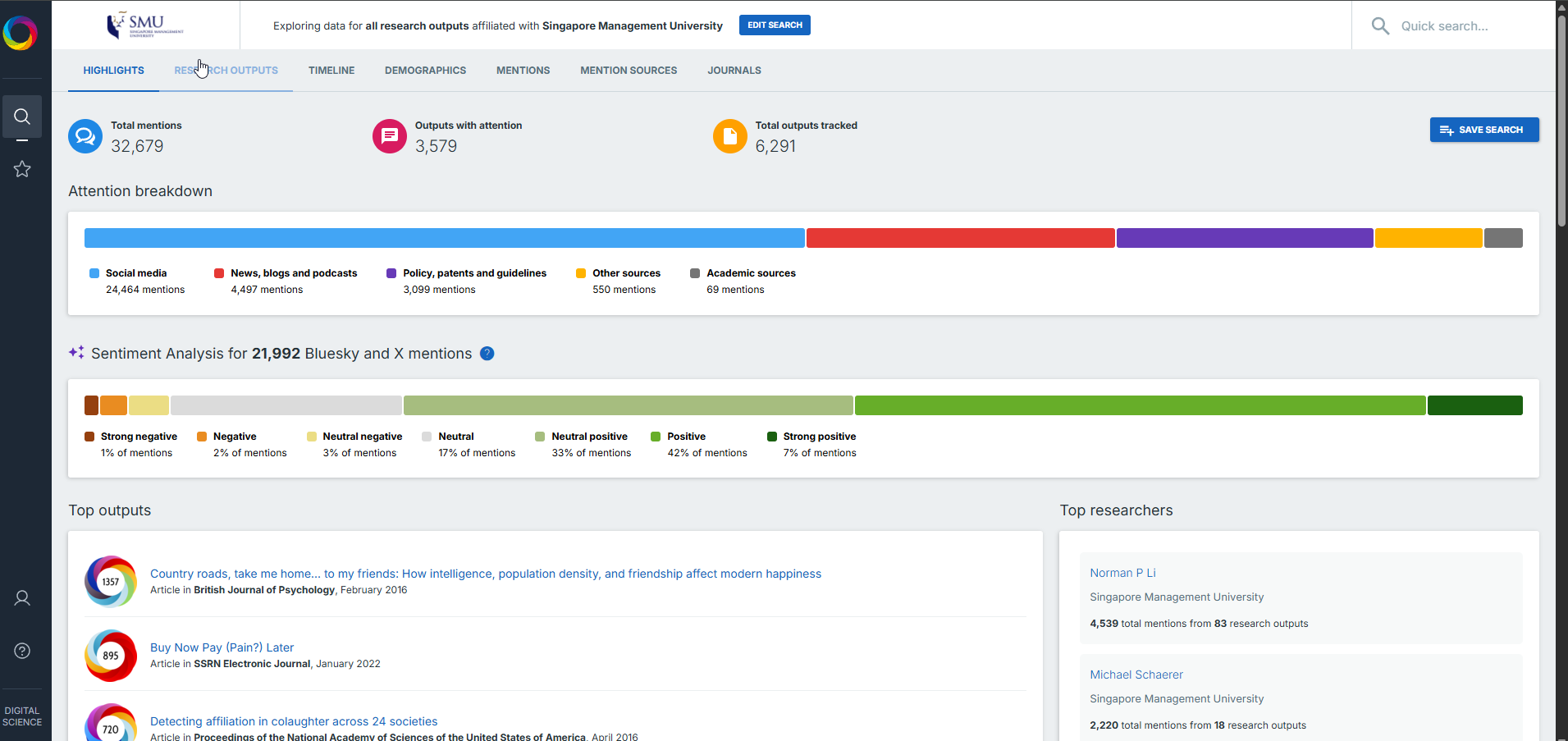
Altmetric Explorer does not replace citation indexes such as Scopus, Web of Science, and Google Scholar. Instead, it complements them by tracking forms of online attention such as mentions in news media, blogs, and social media, and citations in policy documents, patents, Wikipedia and other selected sources.
For SMU researchers, this means there is another way to identify where research may be mentioned and engaged with outside of academic journals, usually before an academic citation can be picked up.
SMU users can access Altmetric Explorer. For a quick orientation, Altmetric's Help Centre provides a 10-minute introduction video.
Why this matters now
Altmetrics have moved from a niche topic in scholarly communication research to something that increasingly appears in institutional reporting, research impact narratives, and external assessments of research visibility.
This connects to a wider conversation at SMU about what research impact means. In her 2024 IPS-Nathan lecture, SMU President Professor Lily Kong argued that universities should look beyond citations and rankings and calls for a more holistic approach to research evaluation, recognising societal contributions alongside scholarly achievements.
Altmetrics could speak to that question. Its value is not that it adds another score to chase, but that it makes visible the kinds of engagement that citations cannot capture: where research is mentioned in news coverage, cited in policy and clinical guidance, referenced by practitioners, or discussed in public. These are traces of the societal reach that might be valuable to study.
It is also true that this kind of attention is starting to surface in external rankings. The Financial Times Research Insights Ranking, for example, assesses business school research using several indicators beyond citation counts, including policy citations, practitioner downloads, and an Altmetric-based attention component, which accounted for 16 per cent weight in its 2025 edition.
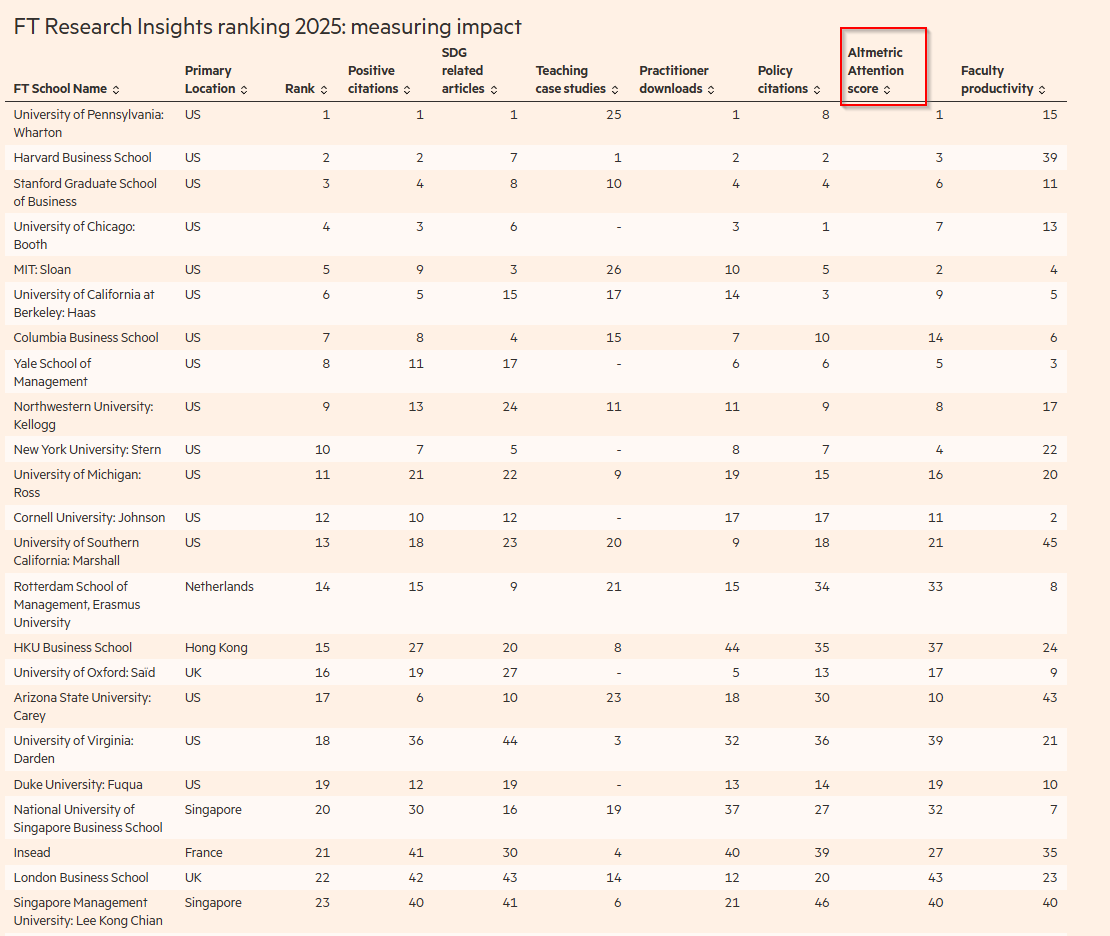
None of this means that altmetrics measure research quality. It means public-facing engagement is becoming more visible in how universities and schools are described and compared, which makes it worth understanding what Altmetric Explorer does and does not capture.
From citations to altmetrics: A brief history
For many years, research visibility of a publication was measured mainly through citations, which show how later scholarly work builds on earlier work but accumulates slowly and reflects attention only within the literature. By the late 2000s, researchers were increasingly sharing, saving, and discussing work through online platforms, which raised an obvious question: could these online traces reveal forms of attention that citation indexes miss?
The term altmetrics is associated with the 2010 document Altmetrics: A Manifesto by Jason Priem, Dario Taraborelli, Paul Groth, and Cameron Neylon. The manifesto did not argue that citations were irrelevant; it argued that they capture only part of the story, and that broader, faster online signals could show how research is noticed, discussed, saved, reused, or applied. It also recognised that altmetrics need careful validation, asking whether these signals reflect meaningful impact or merely online buzz. That discussion continues today.
What does Altmetric Explorer track?
Altmetric Explorer tracks online attention to identifiable research outputs.
Examples of trackable research outputs include: Journal articles, books and book chapters, conference papers, datasets, preprints, working papers, repository records, & other scholarly outputs with recognised identifiers. Altmetric uses persistent identifiers such as DOI*, PubMed ID, ISBN, Handle, arXiv ID, and SSRN ID**
In practice, DOI-based tracking is especially common. However, having a DOI does not guarantee that all online attention will be captured. The output must be identifiable to Altmetric, and the attention must occur in a source that Altmetric monitors.
What sources does Altmetric monitor?
Altmetric monitors a selected online set of attention sources where research may be mentioned, discussed, cited, saved, or linked. These include:
| Source type | What Altmetric may capture |
|---|---|
| News media | Mentions in selected news outlets |
| Blogs | Mentions in selected blogs |
| Policy documents* | References in public policy and guidance documents |
| Social media | Selected public activity from platforms e.g. X & Bluesky |
| Selected public Facebook Pages, not personal profiles | |
| Original post titles, not comments | |
| Wikipedia | References in selected Wikipedia language editions |
| Stack Exchange | Links and references in Q&A posts |
| YouTube | Links in video descriptions |
| Podcasts | Written episode descriptions, not necessarily spoken audio |
| Patents | Citations in patent records |
| Peer review and recommendation platforms | Selected public peer-review and recommendation sources |
| Mendeley | Reader counts |
| Dimensions citations | Citation data from Dimensions |
*For policy documents, SMU users should also be aware of Overton, which is subscribed by SMU Libraries.
This is not the same as indexing the whole web. Altmetric sources are curated. For example, not every blog, news outlet, Facebook page, YouTube channel, or podcast is tracked.
What does a mention need before it is counted?
Because Altmetric tracks a curated set of sources, a mention is most reliably counted when three things line up: the research output has a recognised scholarly identifier and suitable machine-readable metadata on its landing page; the mention appears in a source that Altmetric monitors; and the connection between the source and the output is detectable, usually through a direct link to the output. For some sources, such as news, policy documents, clinical guidelines and patents, Altmetric may also use text mining, but this still depends on sufficient bibliographic information and reliable metadata.
Direct links are safest when they appear in the main body of a post, a video description, or written podcast show notes. Mentions are less likely, or impossible, to be captured if they appear only in places Altmetric does not track, such as comments, likes, shares, images, audio, transcripts, sidebars, untracked pages, or sources outside Altmetric’s curated lists.
Treat Altmetric data, therefore, as evidence of selected forms of online attention, not as a complete record of all public, policy, educational, or societal impact.
See this support page for more information and this page for common reasons for missed mentions.
AI-enhanced features
Altmetric Explorer has also added AI-enhanced features to help users interpret attention data, rather than only reading a score.
The Altmetric Attention Digest is available on Altmetric Details Pages. It provides AI-generated summaries for individual research outputs, drawing together key metrics, influential sources, overall reception, source-specific insights, and possible trigger events behind spikes in attention. This can help researchers quickly understand the story behind an output’s attention, but users should still check the original mentions before using the summary in reporting or impact narratives.
Altmetric’s Sentiment Analysis is also now a standard feature in Altmetric Explorer. It is designed to help users go beyond mention counts by identifying whether relevant conversations are broadly positive, negative, or neutral. This may be useful when assessing public reception or reputational risk, but sentiment labels should be treated as machine-generated interpretations rather than definitive judgements.
How can SMU researchers use Altmetric Explorer?
Researchers may use Altmetric Explorer to:
- Find where their publications have been mentioned outside scholarly citation indexes.
- Identify news, policy, blog, Wikipedia, patent, or social media attention around their work.
- Discover which research outputs are receiving public or practitioner attention.
- Support narrative evidence for research visibility, engagement, or broader influence.
- Find examples of research uptake that may be useful for grant reports, impact narratives, promotion materials, or school-level reporting.
- Compare attention patterns across outputs, topics, schools, funders, journals, or time periods.
- Better understand indicators that may appear in external research visibility exercises, including rankings and institutional benchmarking.
How to search for your own outputs
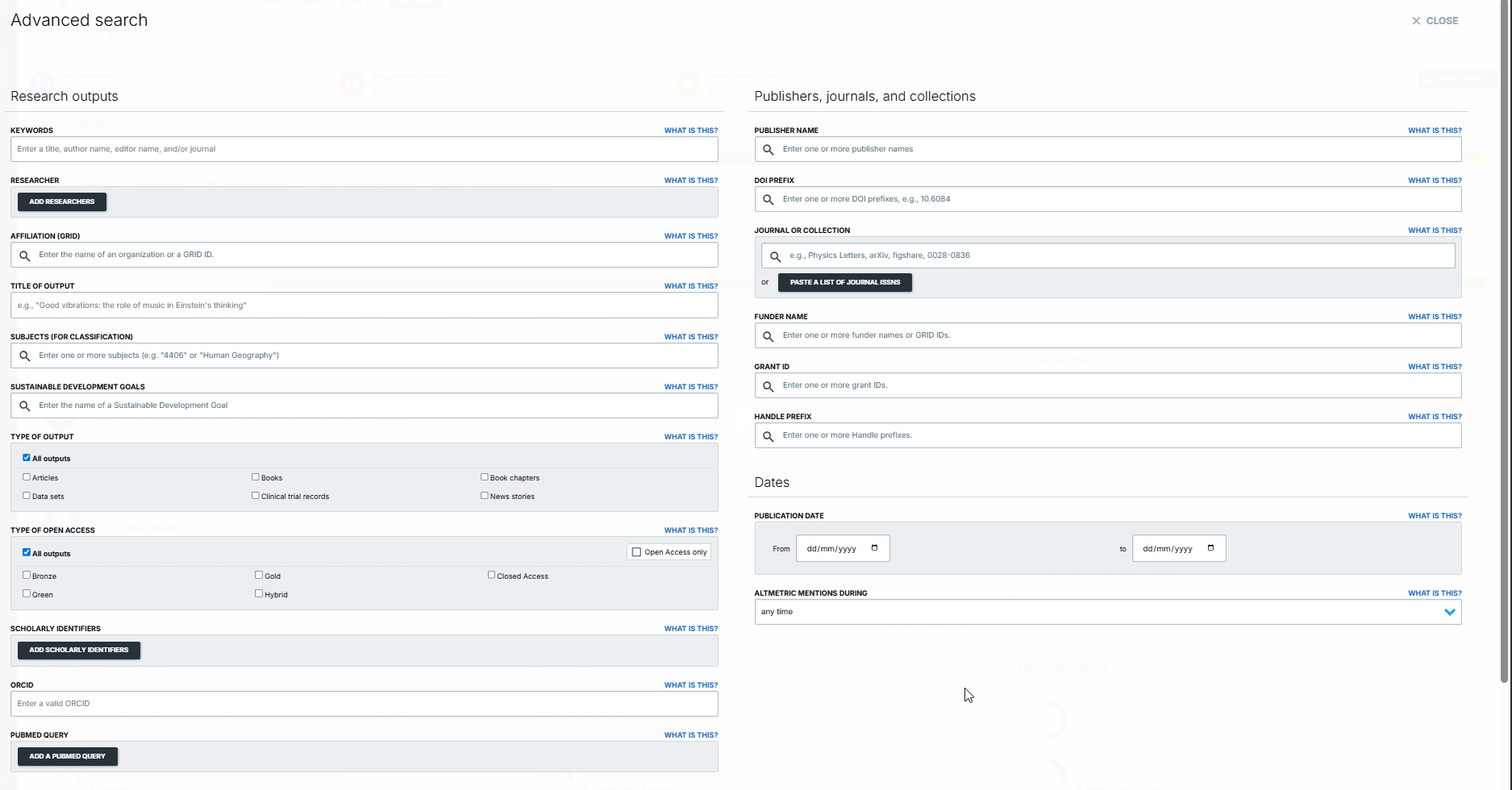
While the advanced search allows you to search by a variety of settings and levels e.g institution, Publisher, Funder, Subject, even SDG, one of the most common use case is to search for output by individual researchers.
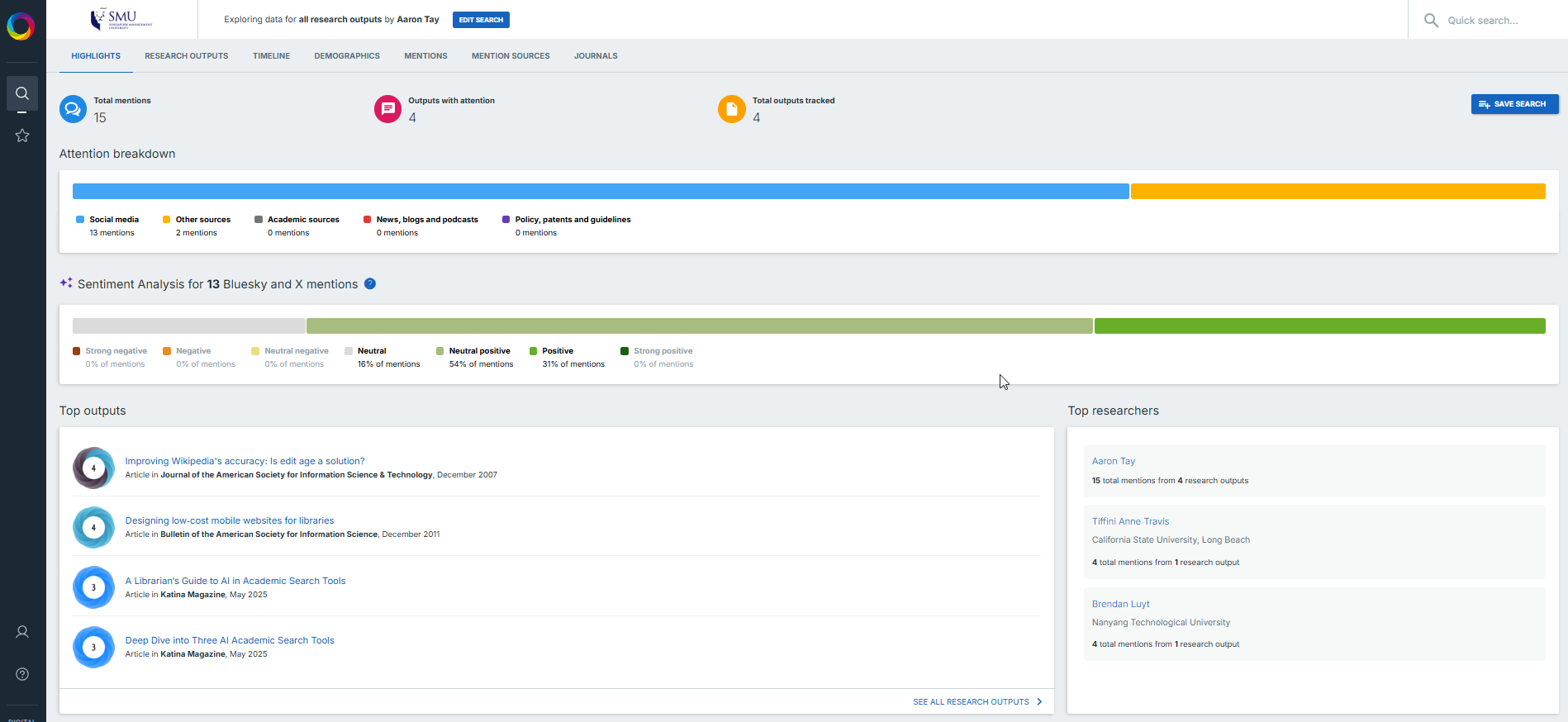
Authors can do this in 3 ways – Search by
1. ORCID: search using your ORCID iD to retrieve outputs listed in your ORCID profile.
2. Researcher: search for your name and the box will populate suggested profiles to add. This can take a while. These are Dimensions profiles which may not be accurate if you have not claimed or cleaned it.
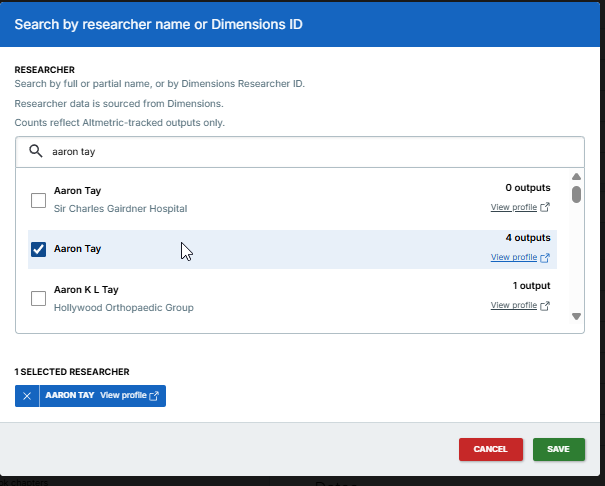
3. Scholarly Identifiers: If both profiles do not seem complete you can directly paste known output identifiers such as DOIs, PubMed IDs, ISBNs, Handles, arXiv IDs, ADS IDs, RePEc IDs, or URLs.
ORCID and Researcher searches may return different results, depending on whether your ORCID record (highly recommended is Setting up an ORCID profile to get maximum coverage from Altmetric) or Dimensions author profile is cleaner and more complete.
Practical checklist for researchers
To make research outputs and online mentions more trackable:
- Use a recognised identifier, such as a DOI, PubMed ID, ISBN, Handle, or arXiv ID.
- Check that the identifier is correct, active, and points to a stable landing page.
- Make sure the landing page has accurate machine-readable metadata, including title, author, publication date, source title, and identifier.
- Link directly to the DOI, publisher page, repository record, PubMed record, arXiv record, dataset page, or other recognised output page.
- Put the link in the main body of the post, news story, blog post, or webpage.
- Avoid relying only on screenshots, unlinked text, images, sidebars, footers, or comments.
- For videos and podcasts, include the research-output link in the written description or show notes.
- For blogs, make sure the link appears in the RSS-visible post body.
- After a mention appears, search Altmetric Explorer using the DOI or other identifier.
- If an eligible mention is missing, check whether the source is monitored and whether the link is visible in the right place.
For more detailed troubleshooting, contact SMU Libraries.
How should Altmetric data be interpreted?
Altmetric data should not be read as a simple measure of research quality. A high Altmetric Attention Score may reflect public interest, controversy, newsworthiness, policy relevance, active promotion, or social media visibility. A low score does not mean a work is unimportant.
The empirical literature supports reading these signals carefully. Studies generally find that social-media-based altmetrics have weak or inconsistent relationships with citation counts, which suggests they often capture different forms of attention rather than the same construct citations measure. For example, Costas, Zahedi and Wouters found that correlations between altmetric indicators and citations were generally positive but weak, while Haustein, Costas and Larivière found a weak relationship between citations and social media metrics. By contrast, Mendeley reader counts tend to show stronger relationships with citations and may act as earlier indicators of later scholarly citation impact. Zahedi, Costas and Wouters found a moderate correlation between Mendeley readership and citation indicators, while Thelwall found that early Mendeley readers correlated with later citation counts in most fields studied.
This should not necessarily be seen as a weakness. If altmetrics simply reproduced citation counts, they would add little information. Their value is that different sources may point to different kinds of attention: scholarly readership, public discussion, media visibility, policy interest, practitioner engagement, or educational use.
The Attention Score itself needs care. It is not a raw mention count but an automated, weighted figure that gives more weight to some sources than others; a news story normally counts for more than a single social media post. The colours of the donut show the mix of sources, while the number is a quick but simplified summary. This is why the details page and the underlying mentions matter more than the score alone.
The most useful questions are not only what the score is, but: Who is mentioning the research, and where? What are they saying about it? Is the attention scholarly, public, policy-related, clinical, educational, commercial, or social? And does it provide useful evidence for an impact narrative?
Used carefully, Altmetric Explorer helps researchers and institutions see forms of attention that traditional citation databases may miss. Used carelessly, it can collapse very different kinds of attention into a single number.
Altmetrics.com donut
Altmetric.com is one company that provides altmetric data. It is part of the Digital Science portfolio (alongside Figshare, Dimensions, Overleaf, and Symplectic Elements). Altmetric Explorer is the institutional product and its donut badge is widely seen on publisher and research-profile pages.
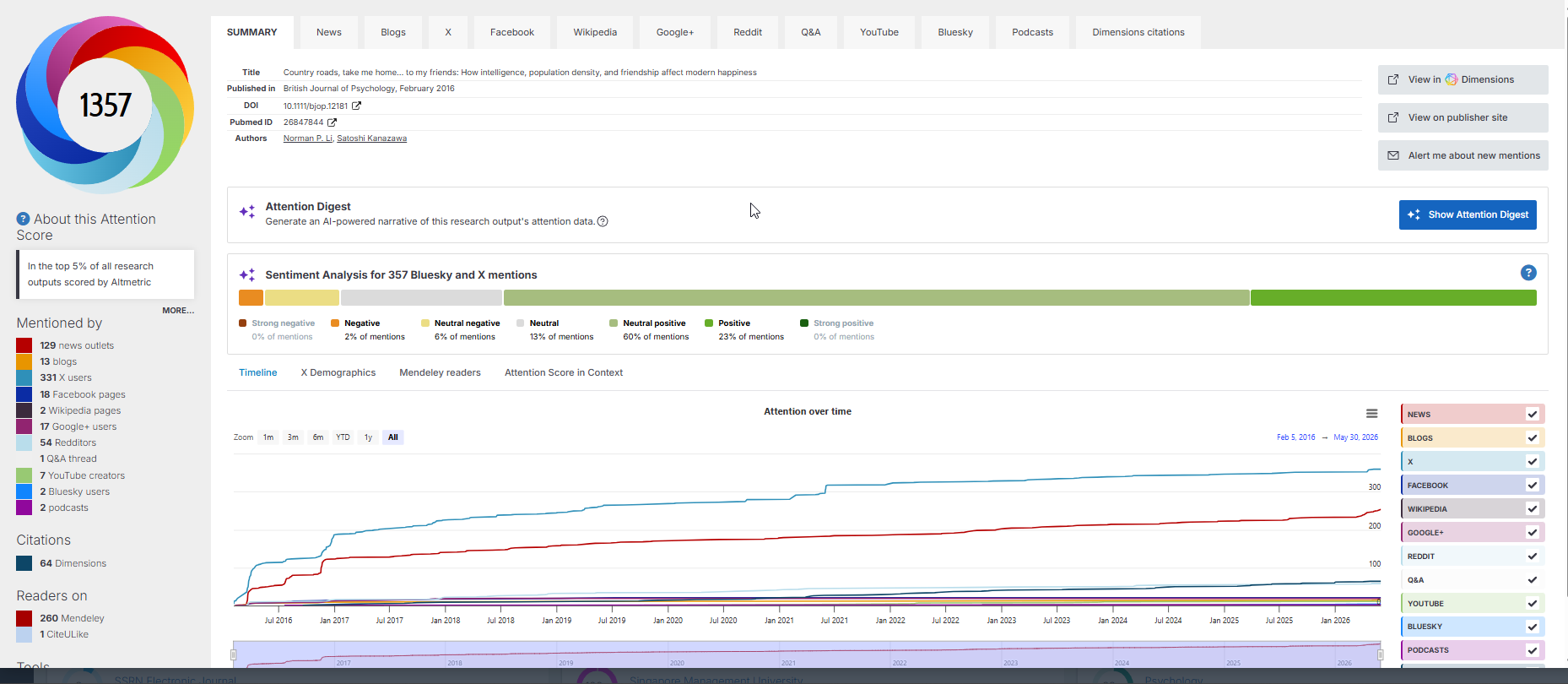
The number in the centre of the donut is the Altmetric Attention Score with the colours of the donut showing the source types contributing to that attention, such as news, blogs, policy, Wikipedia, or social media.
Altmetric is not the only provider. PlumX Metrics (developed by Plum Analytics, now owned by Elsevier) classifies attention into usage, captures, mentions, social media, and citations, and SMU can access the PlumX/Scopus/Scival API.
Bottom line
SMU Libraries’ subscription to Altmetric Explorer gives SMU researchers and research support teams a new way to explore how research outputs are being noticed, discussed, saved, cited, and used in selected online spaces beyond scholarly citation indexes.
Altmetric data is best treated as contextual evidence. It can reveal useful traces of visibility and engagement, especially in news, policy, public, and online environments. But it should be interpreted alongside citations, expert judgement, disciplinary context, and qualitative evidence of research influence.
For more detailed guidance, consult the Altmetric Help Centre or the Altmetric YouTube channel, which includes short tutorials and product walkthroughs.
Give Altmetric Explorer a try!