

By Bella Ratmelia, Senior Librarian, Research & Data Services & Aaron Tay, Head, Data Services
This is the third and final piece in the ResearchRadar series on FORCE2026, the international scholarly publishing & communication conference SMU is hosting from 3–5 June 2026. Part I covered research assessment and impact. Part II covered AI in research workflows. This instalment focuses on sessions relevant to faculty with journal editorial responsibilities — and more broadly, anyone concerned with how scholarly publishing is holding up under pressure.
Registration closes on 24 May 2026
Who is already in the room
It is now a month to FORCE2026 - Over 110 researchers, publishers, and librarians have already registered, from 22 countries. The regional mix:
- Asia: 55%
- North America: 18%
- Europe: 17%
- Oceania: 8%
- Africa: 2%
The roster already includes, among others:
- Academic institutions - Stanford University, the University of Hong Kong, Carnegie Mellon University, Kyoto University, and Erasmus University Rotterdam, University of Bath, King Abdullah University of Science and Technology, Chulalongkorn University etc
- Publishers - Elsevier, Taylor & Francis, Springer Nature, BMJ etc
- Scholarly infrastructure organisations - Crossref, DataCite, ORCID, Overton, Digital Science, and the Computer Network Information Center of the Chinese Academy of Sciences etc
- Open-science and open-access initiatives - the Declaration on Research Assessment (DORA), the Barcelona Declaration on Open Research Information, the Directory of Open Access Journals (DOAJ), and Open Access Australasia etc
That is a genuinely cross-sector, cross industry room, and not one that typically convenes together in Asia to discuss the future of scholarly publishing and communications.
It’s not too late to join them!
The honest question: Does scholarly publishing still work?
It is increasingly hard to find anyone involved in scholarly publishing — authors, reviewers, editors, publishers, librarians — who believes the system is functioning well. Paper mills have been industrialised. Generative AI can produce plausible manuscripts, fabricated peer reviews, and image manipulation that is difficult to detect. Reviewer pools are stretched thin. Retraction counts keep climbing. Assessment cultures continue to reward publication volume over substance.
This is precisely the reckoning Professor Virginia Barbour — Editor-in-Chief of the Medical Journal of Australia and Co-Chair of DORA — will address in her closing keynote, bluntly titled “Publishing in 2026: How we got into such trouble and how we get out of it.”
FORCE2026 is not where you go for vendor pitches or AI boosterism. It is where editors, integrity officers, publishers, and infrastructure providers work through the hard questions together.
Why this matters for SMU faculty
If you hold an editorial position, sit on an editorial board, review extensively, or make institutional decisions about research integrity, the sessions at FORCE2026 offer something the usual conference circuit rarely does: peer conversations grounded in practice and evidence rather than vendor marketing.
Who should attend?
- Faculty who publishes regularly — the pressures editors face show up on the author's side too: unclear AI-disclosure rules, new data-availability and ORCID requirements, unfamiliar submission workflows, and increasingly strange reviewer experiences. If you publish, these sessions explain what is happening on the other side of the desk and why it is changing how your papers are handled.
- Faculty who holds editorial roles or sits on editorial boards
- Faculty who reviews extensively and wants clearer frameworks for handling AI-assisted submissions
- Research integrity officers, research managers, and anyone involved in misconduct cases
- Librarians and publishing support staff working with faculty authors
Selected sessions on research integrity and trust
- [Closing Keynote] Publishing in 2026: How we got into such trouble and how we get out of it — Professor Virginia Barbour names the dysfunctions of the current system directly, and what it would take to rebuild a system that is open, trustworthy, and reproducible. Worth attending even if you attend nothing else on Day 3.
- Trust & Integrity (Day 3 parallel session) — A dedicated session on practical approaches to research integrity, including the shared infrastructure publishers are building to address fraud and paper-mill activity at scale. One such presentation addressing this issue is the presentation - STM Integrity Hub: infrastructural change through new collaborations, “which screens 125,000 manuscripts per month from 40 publishers, powering effective workflows through integrations with 7 submissions systems” For editors handling suspicious submissions, understanding this emerging ecosystem matters.
- Trust in Turbulent Times: Safeguarding Knowledge in the Age of Generative AI — Addresses the specific challenge of maintaining trust in scholarly knowledge when AI can generate plausible but unreliable content at scale.
Selected sessions on AI, editorial policy, and peer review
- [Day 2 Keynote] Surviving the Disruption: Scholarly Communication in the Age of AI — Ian Mulvany (CTO, BMJ Group) draws on direct experience building AI systems for editorial and peer review workflows. This is someone running the systems, not commenting on them from the outside.
- Understanding and Handling Software and Plagiarism in the Age of Generative AI — A birds-of-a-feather session tackling the live policy question: how editors should treat AI-generated content, detection claims, and disclosure requirements. Peer conversation rather than vendor pitches.
- Using AI to determine how interesting citations are — Euan Adie (Overton) on using AI to analyse citation context and significance. Relevant for editors who want to assess actual research influence rather than rely on raw citation counts.
- Managing AI Bot Access to Open Scholarly Infrastructures — Petr Knoth (CORE) on what happens when AI systems scrape journal content at scale. Implications for access, licensing, and the ongoing debate about what published content is worth when it is consumed by bots rather than people.
Selected sessions on open infrastructure, metadata, and FAIR publishing
- Building Resilient Infrastructure (Day 3 parallel session) — The infrastructure layer (identifiers, repositories, metadata) increasingly determines what journals can and cannot do. This session covers what resilient looks like in practice.
- PIDs in Practice (Day 3 parallel session) — Persistent identifiers for authors, institutions, grants, and outputs have moved from nice-to-have to prerequisite for modern editorial workflows. Implementation-focused rather than advocacy-focused.
- Barcelona Declaration and open research information — For editors and publishers weighing the shift toward openly available metadata, and what it means for submission systems, reference lists, and citation data.
- Supporting FAIR Research in Scholarly Publishing with the Editorial Reference Handbook — Practical implementation guidance for editors trying to operationalise FAIR data principles in their own journals.
Two satellite events worth flagging
Two free satellite events are co-located with FORCE2026. Both are separate from conference registration and worth surfacing here since they touch the themes running across this series.
1. Shared Principles, Regional Realities: Advancing Research Assessment Reform in the Asia-Pacific (2 June)
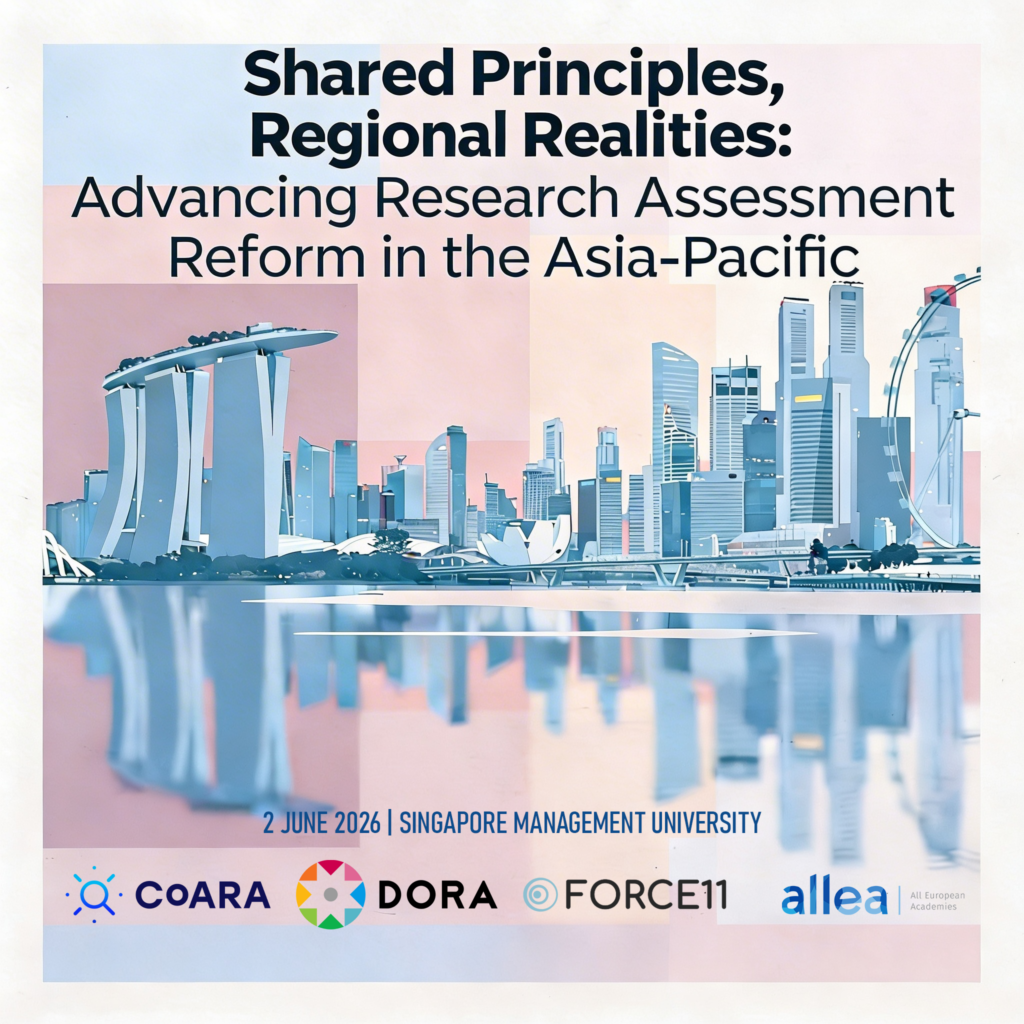
Co-organised by The Coalition for Advancing Research Assessment (CoARA) and Declaration on Research Assessment (DORA) on the pre-conference day. A full-day multi-stakeholder dialogue on where the Asia-Pacific research community sits on the reform journey, what is getting in the way (entrenched incentives, cultural and institutional differences), and what practical pathways look like. Aimed at researchers, publishers, research managers, funders, policymakers, and early- and mid-career researchers.
- Date: 2 June 2026, SMU campus
- Cost: Free
- Format: In-person only, capped at 50 participants, selection on a rolling basis via declaration of interest
- Declaration of interest form: https://forms.gle/2ExyEFqi2sai3epL8
- More information: FORCE11 event page
This is the single best entry point for anyone in SMU leadership, research management, or early-career roles who wants direct exposure to CoARA and DORA — the two most influential international assessment reform movements — without flying to Europe.
2. DataCite Connect Singapore 2026 (5 June)
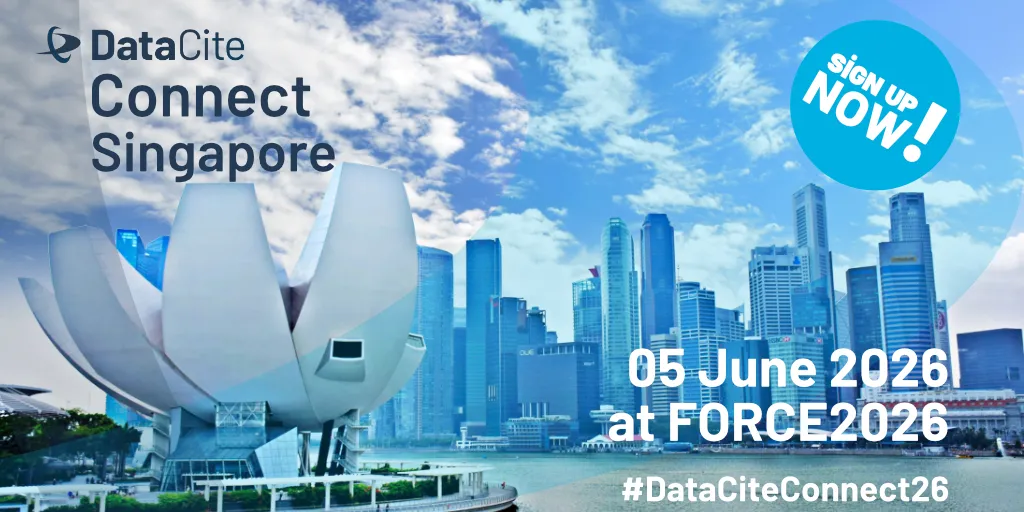
Co-located with the final conference day. A DataCite forum for members and the broader community to discuss best practices, identify collaboration opportunities, and give feedback on DataCite services. Relevant for anyone working on research data, persistent identifiers, or data citation infrastructure.
- Date: Friday, 5 June 2026, 14:00–17:00 SGT
- Venue: Learning Labs 3 & 4, Kwa Geok Choo Law Library, SMU
- Cost: Free (FORCE2026 registration is not required to attend)
- Capacity: 40 participants, first-come first-served
- Registration: datacite.org event page
- More information: FORCE11 event page
Note the timing — it runs in the afternoon after the FORCE2026 closing remarks end around 12:15, so attending both on the same day is straightforward.
The bottom line
The pressures on scholarly publishing are not going to ease. Editors who understand the integrity, infrastructure, and AI dimensions of the current moment are better equipped to make decisions that hold up, and better positioned to push back on expectations that do not.
FORCE2026 is opened by SMU President Professor Lily Kong and closes with Professor Virginia Barbour. For Singapore-based readers, that line-up is a taxi ride away. The equivalent FORCE conference in Europe or North America is a 13-hour flight, airfare of SGD 2,000 or more, four nights of hotel, jet lag on both ends, and several days away from family. This time the conference is on your usual campus, you sleep in your own bed, and a day pass is USD 150.
Interested in joining us?
Over 100 researchers, publishers, and librarians have already registered.
- Dates: 3–5 June 2026 (pre-conference 2 June)
- Venue: SMU campus
- Standard rate: USD 350 (available until 24 May 2026)
- Day Pass: USD 150 per day — if you cannot commit to the full three days, the day pass lets you attend the single day most relevant to your role. Day 3 (5 June) is the natural pick for editors and anyone focused on publishing and integrity, anchored by Professor Barbour's closing keynote and the Trust & Integrity and Building Resilient Infrastructure parallel sessions.
- Registration site: https://event.fourwaves.com/force2026/
Note: a 3% platform processing fee applies at checkout. Registration closes on 24 May 2026.
We also thank our sponsors of FORCE 2026 for their support.
This is the final instalment of the ResearchRadar FORCE2026 series.