

By Aaron Tay, Head, Data Services & Yeo Pin Pin, Head, Research Services
Welcome back to our returning researchers, and a very warm welcome to those joining the SMU community for the first time!
As we begin the new academic year, the Research & Data Services (RDS) team at SMU Libraries is excited to share several new resources, services, and enhancements designed to help researchers work smarter, build new skills, and maximise the impact of their research.
Whether you're starting a new project, conducting a systematic review, exploring AI-powered research workflows, or looking to strengthen your research skills, there is plenty to discover this semester.
What's new at a glance:
- Research skills & learning — LIB002, our new self-paced module covering the whole research lifecycle; deeper skills training via SAGE Campus and DataCamp; and PhD-level methods training with Instats, available from September 2026.
- Discovery & access — a refreshed SMU Libraries Search with natural language searching, plus LibKey Nomad, which now delivers full-text access links directly on websites of ChatGPT, Claude.ai, Gemini and Copilot.
- AI research workflows — connect your AI assistant to scholarly databases with Consensus and Scite MCP, and use the newly added MCP support in Undermind.ai
- Research impact — track attention to your work in news, policy and social media with Altmetric Explorer, with a webinar on 19 August 2026. You can also enjoy access from LLM platforms via MCP!
- Evidence synthesis — screen and manage systematic reviews collaboratively with Covidence.
Read on for the details behind each of these, or skip straight to the sections most relevant to your work. A summary table of resources by research need appears at the end of this article.
Research Skills & Learning
Researchers need more than subject knowledge to succeed. They must be able to find and evaluate information, select appropriate research methods, manage and analyse data, communicate their findings, and assess how emerging technologies such as AI can support their work.
Over the past two years, SMU Libraries has expanded its research support to address these changing needs. Researchers can now access a growing range of guidance, learning platforms and specialist tools, whether they need a broad introduction to the research process or advanced training in a particular method.
LIB002: SMU Specific - Build Your Research Skills at Your Own Pace
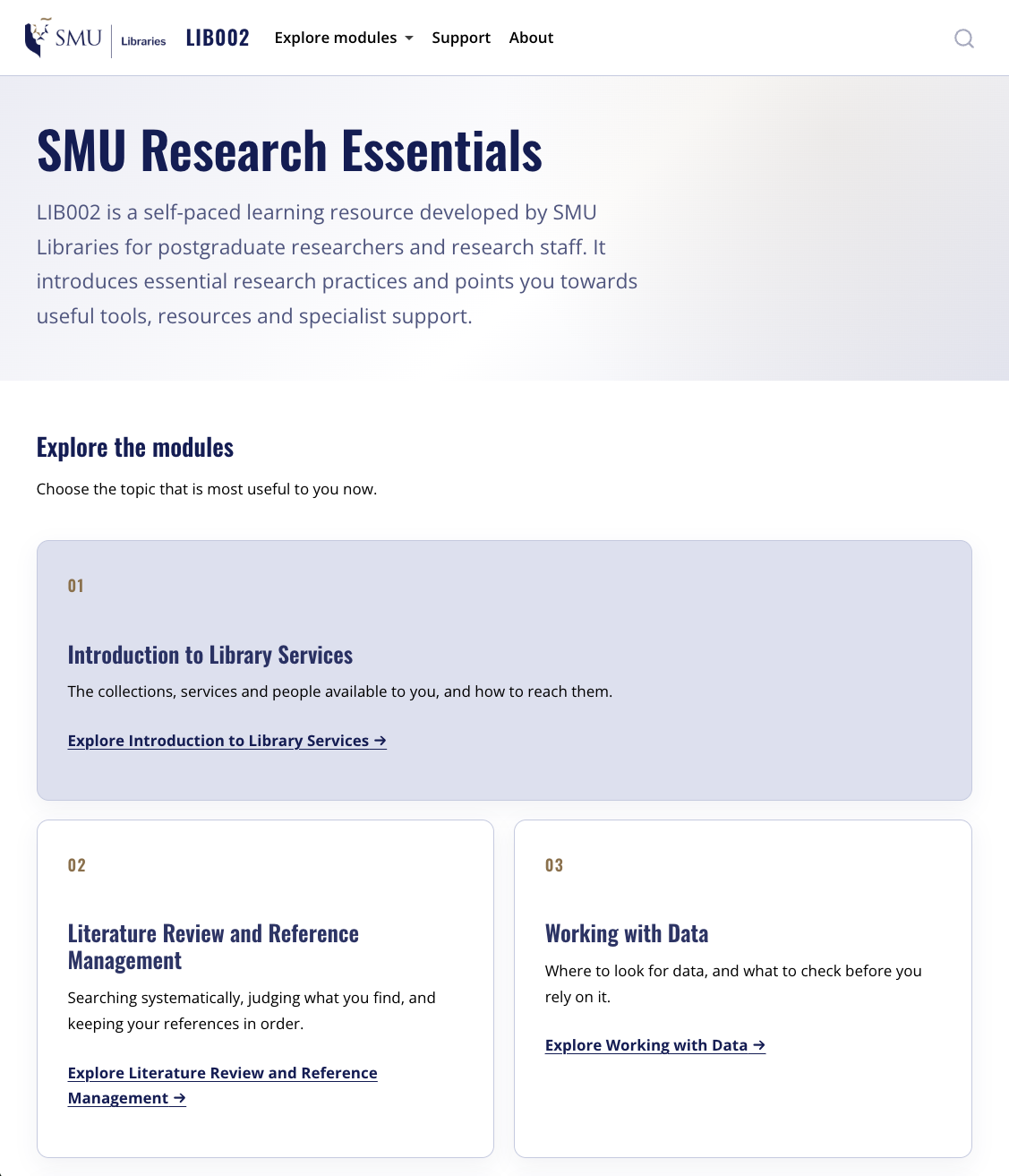
Developed by the Research & Data Services team, LIB002 provides researchers with an overview of the essential skills, resources and services available across different stages of the research lifecycle. It covers areas such as literature searching, research data, scholarly communication and the appropriate use of AI tools in research.
Rather than having to discover each service or resource separately, researchers can use LIB002 as a starting point for understanding what support is available and when it may be useful.
Whether you are beginning your first research project, refreshing your existing knowledge or exploring how SMU Libraries can support your work, LIB002 offers a flexible way to strengthen your research foundations. You can complete the module at your own pace and return to individual sections whenever needed.
Learn more about LIB002 in our research radar piece, or access it directly.
Develop Your Research Skills Further with SAGE Campus
After gaining an overview through LIB002, researchers who want to develop particular skills in greater depth can continue their learning through SAGE Campus.
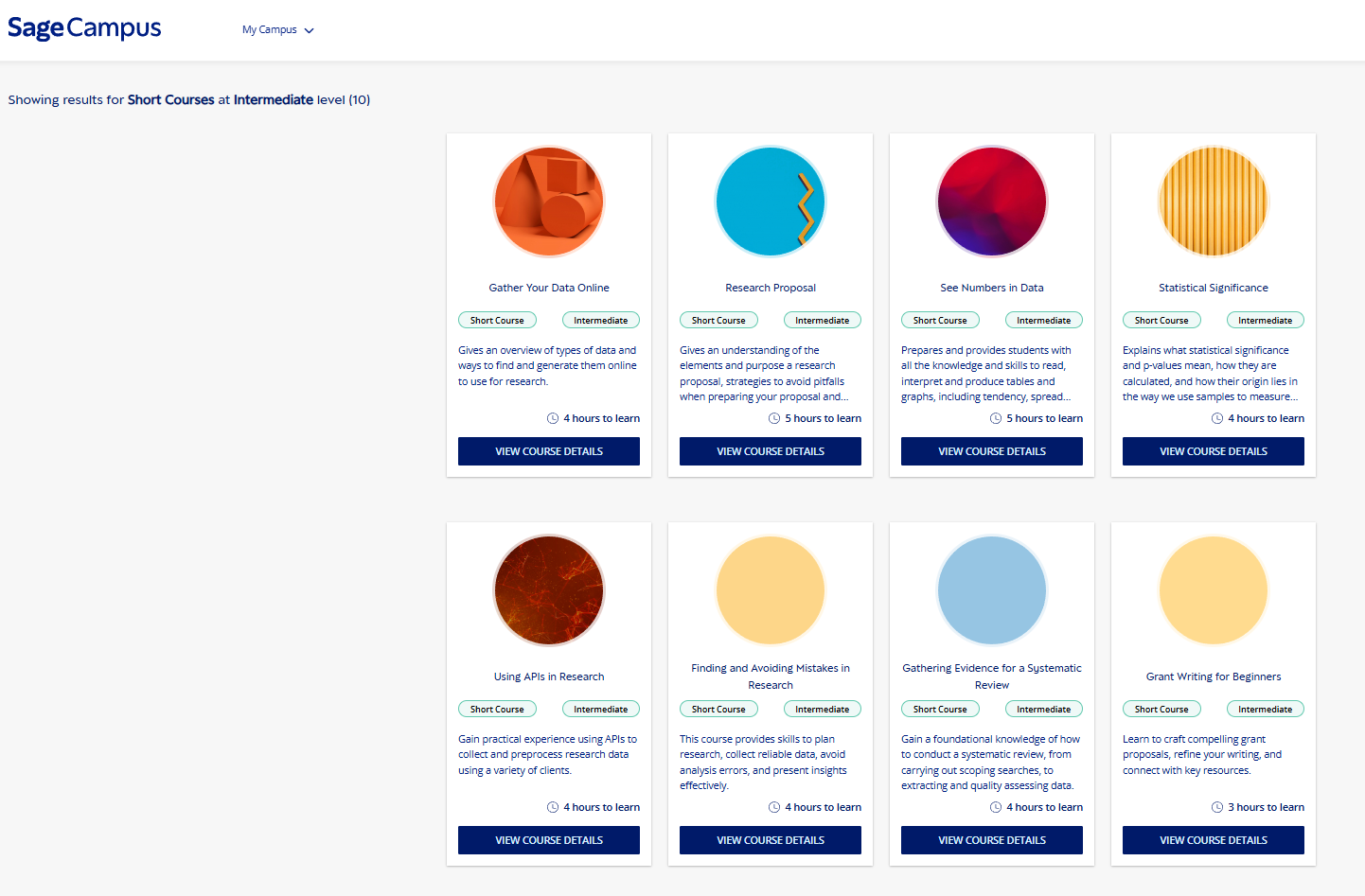
SAGE Campus is a self-paced online learning platform developed specifically for academic researchers. Following a successful trial, it became a permanent addition to SMU Libraries' collection earlier in 2026. The platform provides more than 280 hours of structured learning through readings, videos, interactive activities and assessments.
- Courses cover areas including:
- literature searching and information literacy;
- research design and methods;
- data literacy, visualisation and data science;
- scholarly writing and publishing;
- journal selection and peer review;
- AI and research workflows; and
- academic and professional development.
Whether you are learning a new methodology, improving your search strategy or preparing a manuscript for publication, SAGE Campus provides a convenient way to build your research capabilities throughout the year.
Build Practical Data and AI Skills with DataCamp
Researchers who want hands-on training in data analysis and programming can also use DataCamp. It offers more than 500 courses, projects and practice exercises covering Python, R, SQL, statistics, machine learning, AI, Tableau and Power BI.
Short lessons are combined with interactive, browser-based exercises, allowing learners to apply new concepts immediately. DataCamp licences are limited; request access via online form.
Advanced PhD-level Research Methods Training with Instats
Learning doesn't stop after coursework.
Researchers seeking more advanced or specialised methods training will soon also have access to Instats, the Institute for Statistical and Data Science.
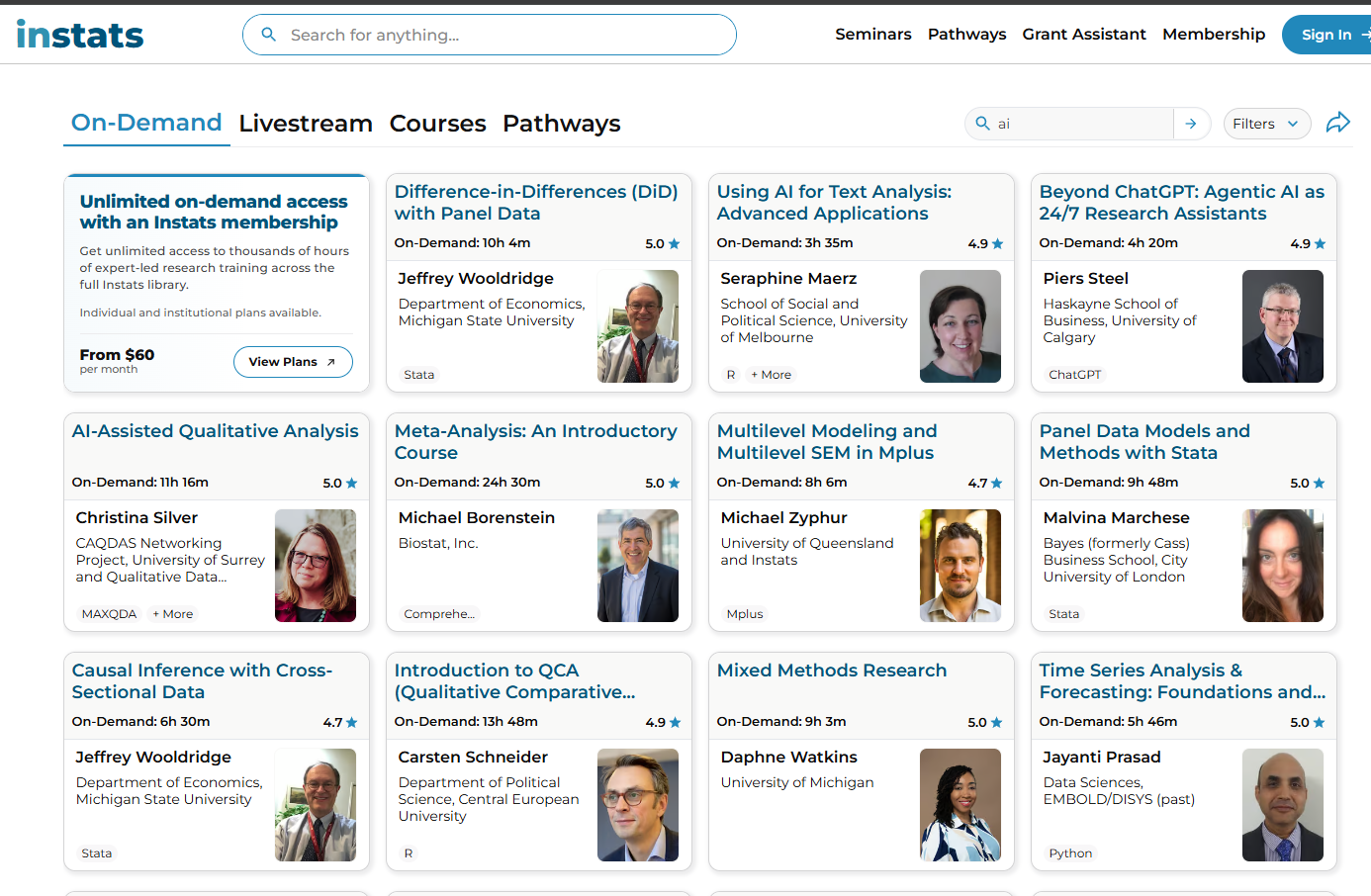
Instats offers PhD-level training delivered by renowned researchers and subject experts such as SMU's School of Social Science Dean, Kenneth Benoit. Its seminars cover areas such as:
- advanced statistics and research methods;
- qualitative and mixed-methods research;
- AI-supported research workflows;
- text and network analysis; and
- research software including R, Python, Stata, SPSS, Mplus and NVivo.
Following the trial in May 2026, SMU Libraries has subscribed to the platform, which will be available to the SMU community from September 2026. Look out for further information on accessing Instats in September 2026.
Together, LIB002, SAGE Campus, Datacamp and Instats (together with less specialised platforms like Udemy Business, Linkedin Learning) provide researchers with a flexible learning pathway: begin with an overview of SMU Libraries' research support, develop foundational and intermediate skills at your own pace, and progress to more advanced methodological training when required.
Discover and Access Research More Efficiently
Explore the Refreshed SMU Libraries Search
Finding relevant literature is often the first step in any research project.
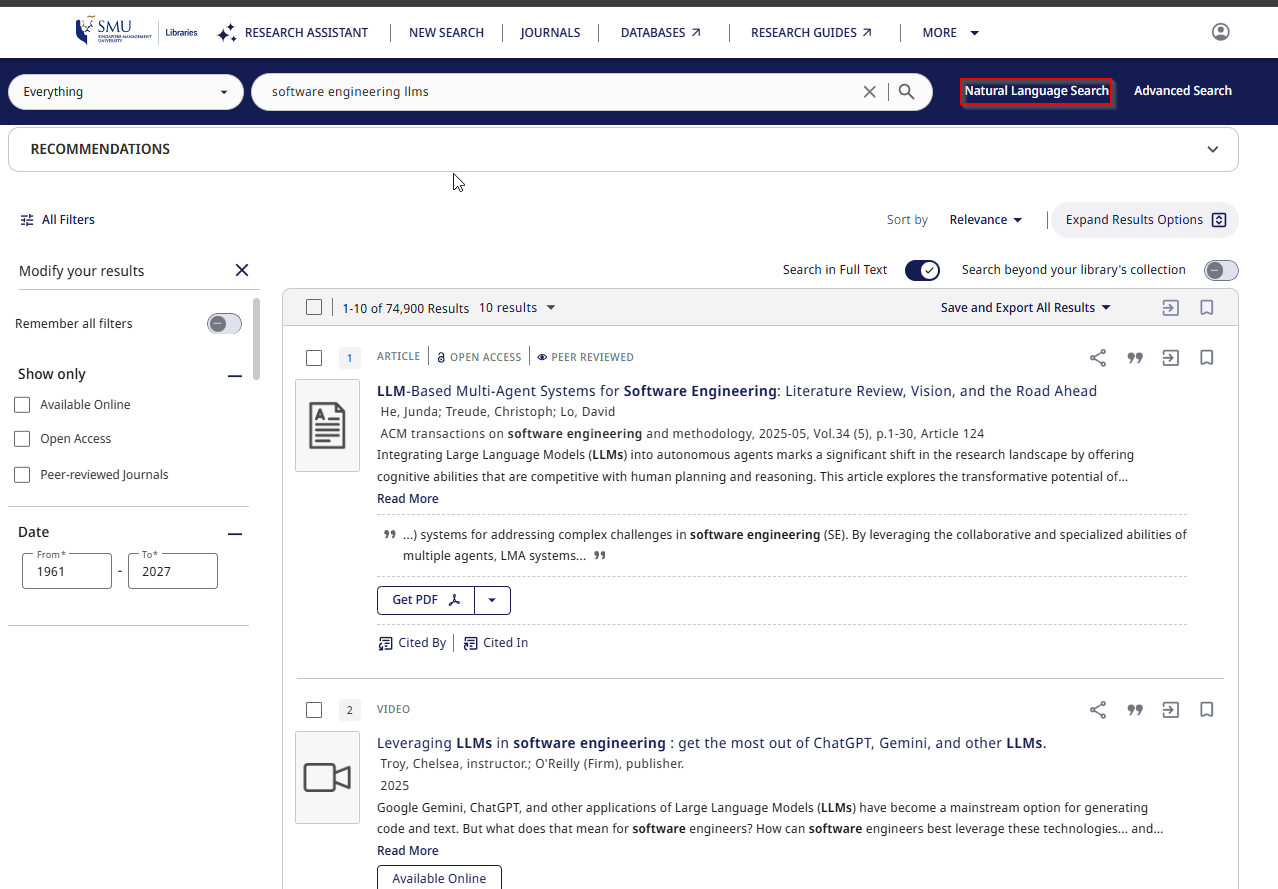
The refreshed SMU Libraries Search provides a simplified discovery experience for books, journal articles, theses, databases, and other scholarly resources available through the library.
Whether you're conducting a literature review, searching for a known article, or exploring a new research topic, SMU Libraries Search offers a single starting point for discovering scholarly content from across the library's collections.
In particular, check out the new natural language search option that converts your query input into Boolean search strategies.
Get Full-Text Access Directly from ChatGPT, Claude.ai, Gemini and Copilot via LibKey Nomad
Many researchers are incorporating AI tools such as ChatGPT, Claude, Gemini, and Microsoft Copilot into their workflows for literature discovery, brainstorming, and research assistance.
But finding an article is only half the battle. You still need access to the full text.
Ever experienced this? You click on a link, land on some interesting journal article on say the Wiley Platform, but when you try to download full-text, you hit a paywall because the system is unable to recognise that you are from SMU.
The Libkey Nomad browser extension once installed solves this issue by automatically generating a popup badge with a link to the full text via SMU subscriptions.
But now the browser extension now integrates not just with major scholarly platforms but also major AI platforms such as chatgpt.com, Claude.ai and Gemini.com
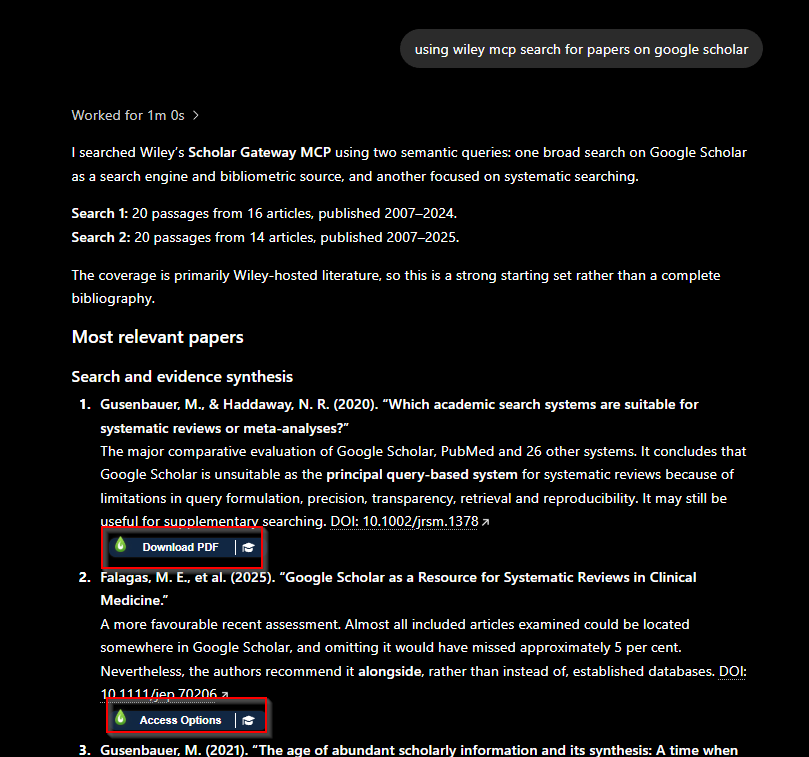
As you can see above, a search in ChatGPT.com for papers results in Libkey Nomad browser extension, leading to buttons overlaid with links to full text or access options.
Instead of manually hunting for PDFs, researchers can move directly from a citation to the article itself with just a few clicks.
For researchers exploring AI-assisted literature discovery, LibKey Nomad is one of the easiest ways to improve their workflow.
Take Your AI Research Workflow Further with Consensus, Scite MCP and LibKey Nomad
Many researchers are already using ChatGPT, Claude, Gemini, to explore new topics, identify relevant papers, and make sense of unfamiliar literature. New tools built on the Model Context Protocol (MCP) are making these workflows even more powerful by connecting AI assistants directly to search scholarly research databases.
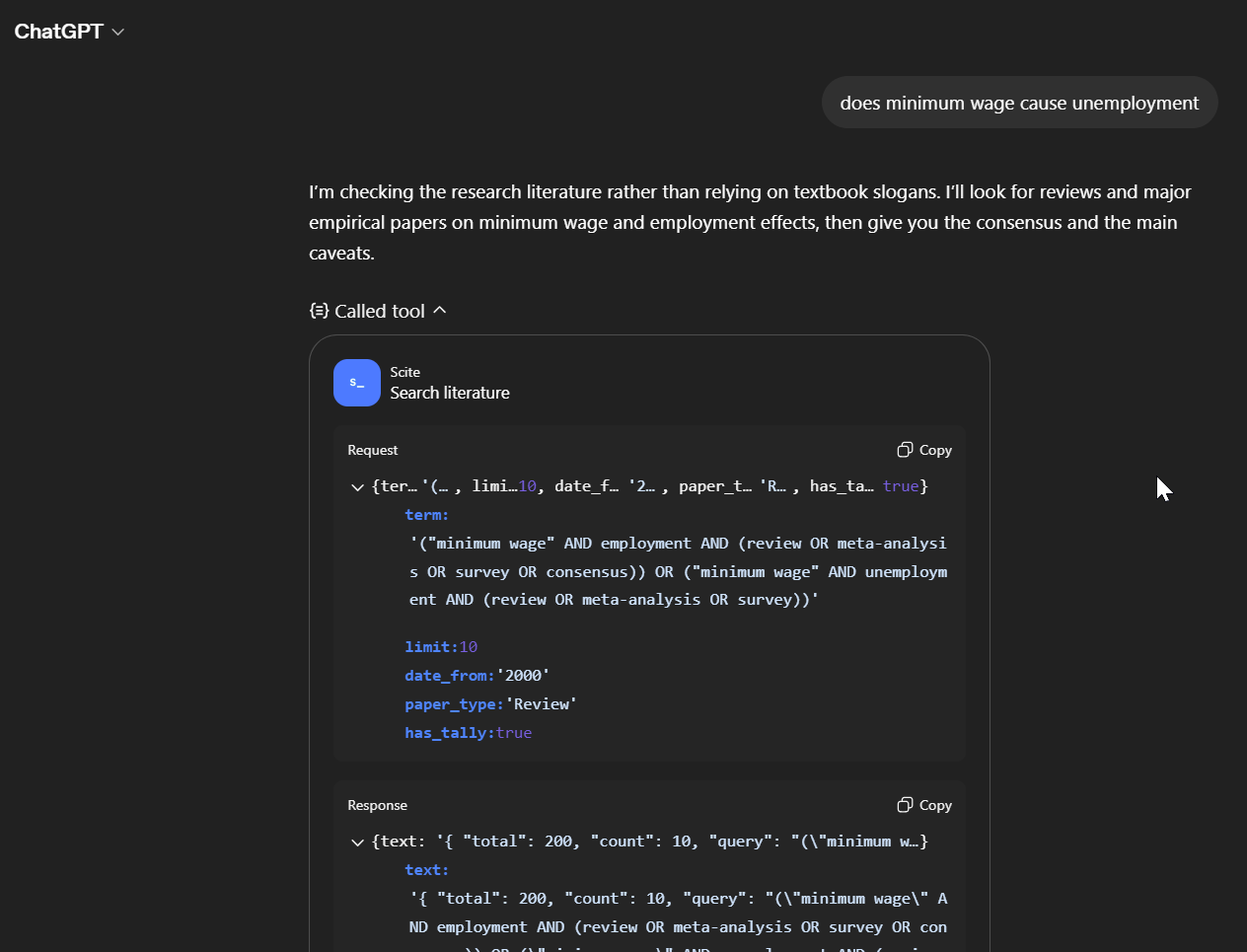
Some tools worth exploring via our SMU subscriptions are Undermind.ai, Consensus and Scite MCP:
- Consensus enables AI assistants to search a large collection of peer-reviewed research papers, helping researchers discover relevant studies, identify evidence, and generate literature summaries grounded in scholarly sources.
- Scite MCP brings Scite's Smart Citations into AI workflows, helping researchers verify claims, identify supporting and contrasting evidence, and understand how findings have been discussed across the scholarly literature.
For full details on why you might want to do this and instructions to connect them to ChatGPT, Claude or even SMU AI Studio Chat (SMU staff only), see our recent article - What If Claude or ChatGPT Could Search Academic Databases For You — and Then Do Something Useful With the Results?
If you use such tools to search within ChatGPT or Claude you should obviously consider pairing it with LibKey Nomad, as mentioned above.
NEW! Undermind.ai adds MCP connector support
Undermind.ai is our premium and popular Deep Research tool, made available to Post-graduates, Faculty and staff (register with SMU email) with hundreds of unique users using it every month.
They have recently added MCP support across multiple platforms.
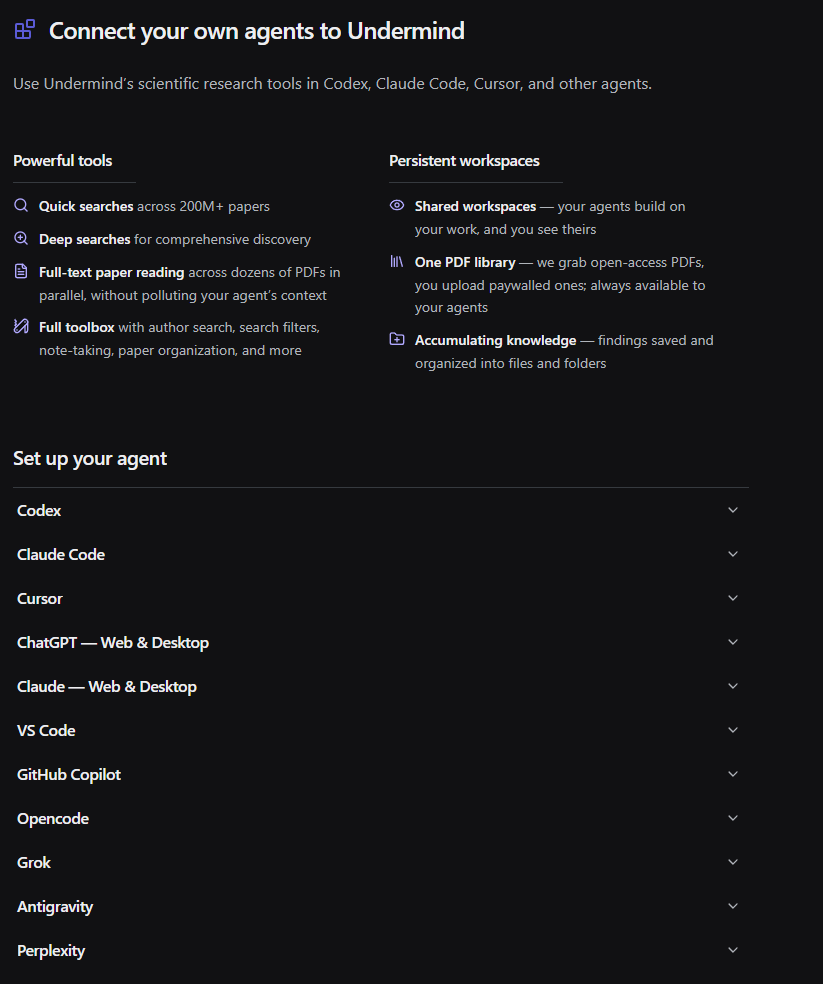
While Scite and Consensus MCP allows the LLM you have connected to to do searches via the two academic search engine, Undermind's MCP capabilities go further.
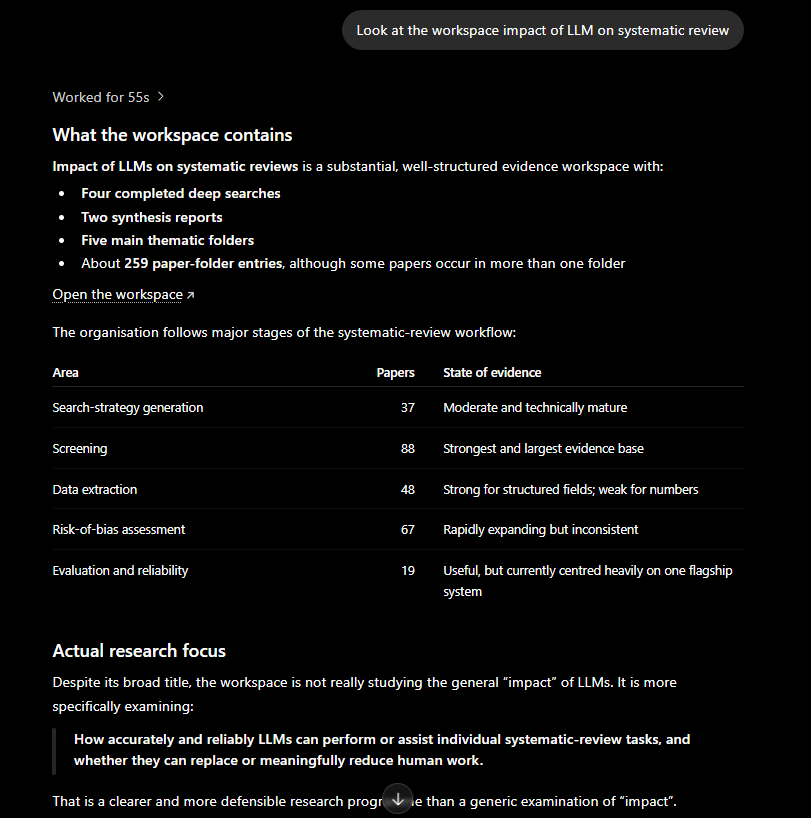
Undermind MCP supports the new workspace features in Undermind Projects. This allows your LLM to use the MCP connect to pull from prior searches and reports already done or start new searches and topics.
NEW! Altmetric.com adds MCP connector support
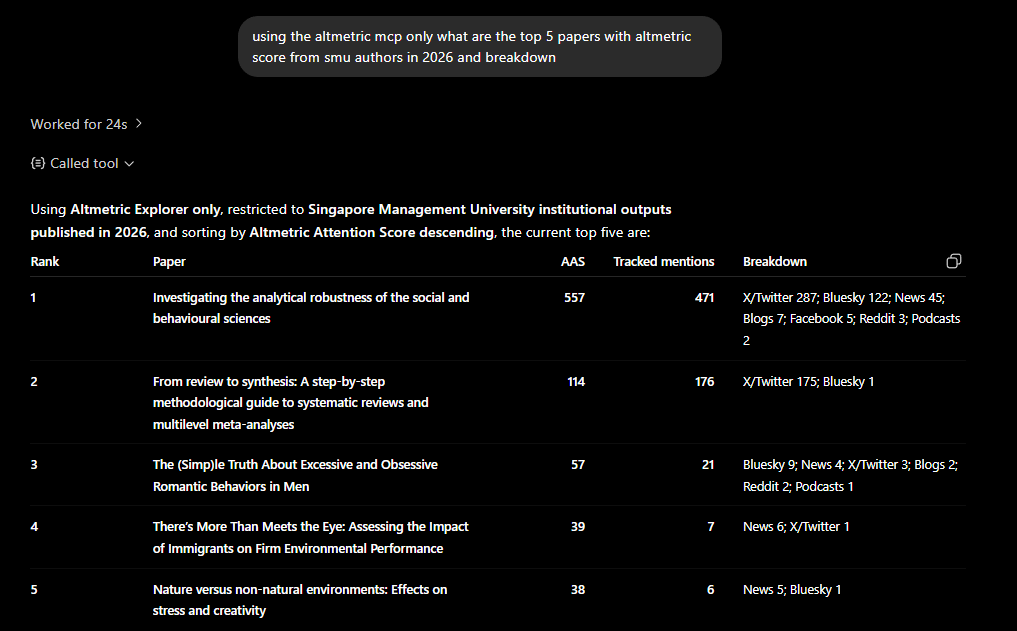
Our institutional subscription to altmetric.com (see below) also comes with MCP connector support across multiple platforms. Our early testing shows this works well in ChatGPT, Codex and Claude Code.
Research Impact & Scholarly Communication
Understand the Reach of Your Research with Altmetric Explorer
Impact of your research extends far beyond academic citations.
SMU Libraries now provides access to Altmetric Explorer, a platform that helps researchers understand how their work is being discussed across news media, policy documents, blogs, social media, and other online sources.
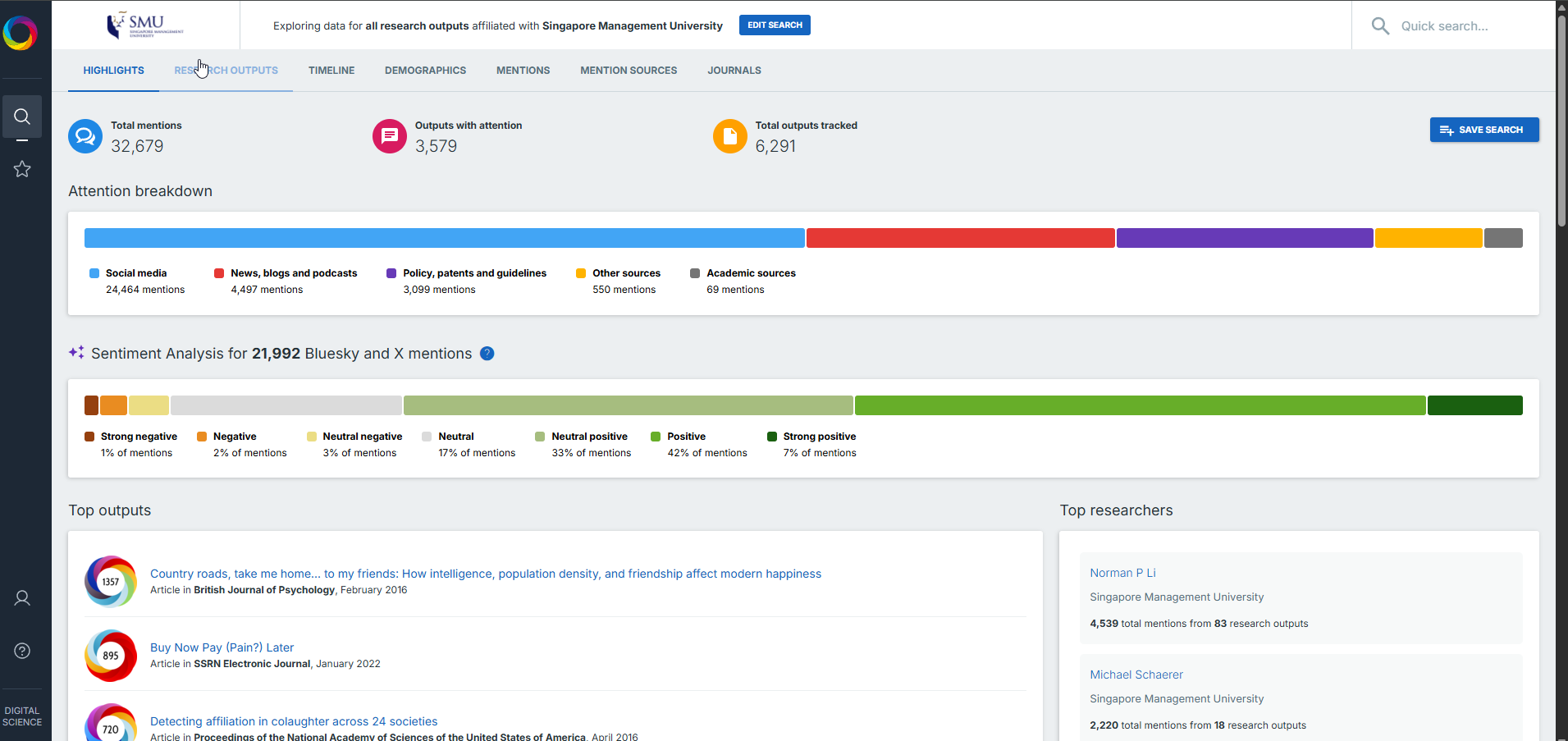
Using Altmetric Explorer, researchers can:
- Track online attention to publications
- Identify policy and practitioner engagement
- Discover media coverage of research
- Demonstrate broader societal impact
For researchers interested in understanding the wider influence of their work, Altmetric Explorer offers valuable insights that complement traditional citation metrics. A citation tells you who cited your work. An altmetric tells you who is talking about it.
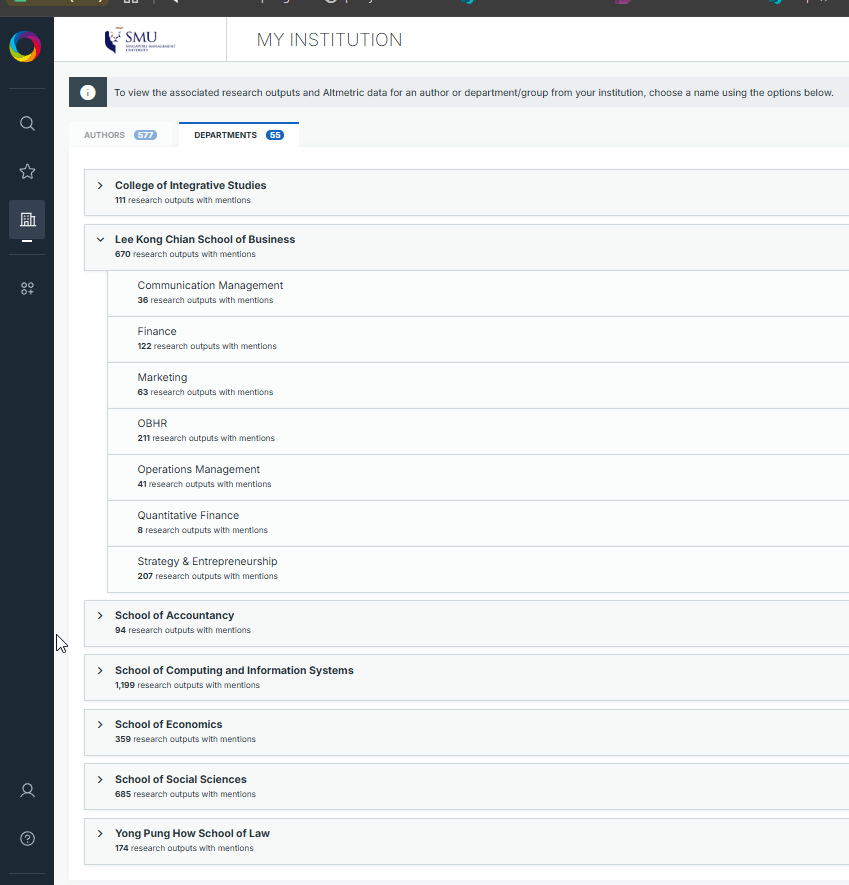
You can even filter by School (e.g. LKCSB) or department (e.g. Marketing).
Access Altmetric Explorer here or attend our online webinar on Altmetrics.com on Wednesday, August 19, 2026 . As already mentioned, you can also access Altmetric stats via MCP on LLM platforms.
Evidence Synthesis & Literature Reviews
Simplify Systematic Reviews with Covidence
Systematic reviews, scoping reviews, and evidence synthesis projects often involve screening large volumes of literature and coordinating decisions across research teams.
To support these workflows, SMU Libraries now provides access to Covidence via an institutional license, one of the world's most widely used evidence synthesis platforms.
Covidence helps researchers:
- Import and organise references
- Collaborate on screening decisions
- Conduct title and abstract review
- Manage full-text review workflows
- Support transparent and reproducible evidence synthesis
For researchers embarking on a systematic review this year, Covidence can significantly reduce administrative overhead while improving collaboration and transparency.
Interesting in trying Covidence? Sign in with SSO here.
Looking Ahead
Research workflows continue to evolve rapidly. New AI-powered discovery tools, research impact platforms, and learning opportunities are creating exciting possibilities for researchers across disciplines.
This academic year, we encourage researchers to explore:
| Research Need | Resource |
| Research skills orientation | LIB002 |
| Self-paced research skills development | SAGE Campus |
| Data science, programming and AI skills | DataCamp |
| Advanced research methods training | Instats |
| Literature discovery | SMU Libraries Search |
| Natural language searching | SMU Libraries Search |
| Access full text from AI platforms like ChatGPT, Claude.ai, Gemini and publisher platforms | LibKey Nomad |
| AI-powered scholarly discovery in LLMs | Consensus, Scite and Undermind MCP |
| Research visibility and impact tracking | Altmetric Explorer, via MCP |
| Systematic reviews and evidence synthesis | Covidence |
At SMU Libraries, we remain committed to supporting researchers throughout every stage of the research lifecycle, from discovery and learning to publication and impact.
Here's wishing all members of the SMU research community a productive, rewarding, and successful academic year ahead.